Home
Class 11
PHYSICS
A monkey of mass 40 kg climbs on a rope ...

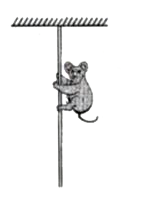
A monkey of mass 40 kg climbs on a rope (Fig) . Which can stand a maximum tension of 600 N .In which of the following cases will the rope break : the money
(a) climbs up with an acceleration of 6 `m s^(-2)`
(b) climbs dow with an acceleration of ` 4ms^(-2)`
(c ) climbs up with a uniform speed of ` 5 ms^(-1)`
falls down the rope nearly freely under gravity ? ( ignore the mass of the rope )

Text Solution

Verified by Experts

Here , mass of monkey m = 40 kg
Maximum tension the rope can stand
T = 600 N
in each case , actual tension in the rope will be equal to apparent weight of money (R ). The rope will break when r exceeds T .
(a) When monkey climbs up with
`a = 6 ms^(-2)`
` R = m(g+a)`
`= 40 (10+6)`
= 640 N (Which is greater than T )
Hence the rope will break .
(b) Force of limitating frcition on body A
`f_(1) = mum_(1)g = 0.15 xx 5xx 9.8`
= 7.35 N
` :. ` Net force exerted by body A on body body B
`F" = F - f_(1) = 200 - 7.35`
= 19265 N
This is to the right
Reaction of a body B on body A = 192.65
N to the left wen the hortion is removed , the system of two bodies will move under the action of net force
`F^(1) = 177.95 N `
Acceleration produced in the system
`F^(1) = 177.95 `
`a = m_(1)+m_(2) = 5+10`
` = 11.86 ms^(-2)`
Force producing motion in body A
`F_(1) =m_(1)a = 5 xx 11.86`
` = 59.3N`
` :. ` Net force exerted by A on body B , when partition is removed
`= F - F_(1) = 192.65 - 59.3 `
` = 133. 35 N `
Hence the reaction of body B on A , when partition is removed = `133.35 N ` to the left Thus answer to (b) do change .
(b) When monkey climts down with a = ` 4 ms^(-2) R = m(g - a) = 40 (10-4)= 240 N `
Which is less than T .
` :. ` The rope will not break .
(c ) When monkey climbs up with a uniform speed `v = 5 ms^(-1)` .Its acceleration .
a = 0
` :. R = mg = 40 xx 10 = 400 N , ` which is less than T .
` :. ` The rote will not break
(d) When monkey falls down the rope nearly freely under gravity
a = g
` :. R = m(g-a) =m(g-g) = zero `
Hence the rope will not break .
Promotional Banner

Similar Questions

Explore conceptually related problems

A monkey of mass 40 kg climbs on a rope. which can stand a maximum tension of 600 N. In which of the following cases will the rope break: the monkey (a) climbs up with an acceleration of 6 m s^(-2) (b) climbs down with an acceleration of 4 m s^(-2 ) (c) climbs up with a uniform speed of 5 m s^(-1) (d) falls down the rope nearly freely under gravity? (Ignore the mass of the rope).

A boy of mass 40 kg climbs up a rope with an acceleration of 2 ms^(-2) . What is the tension in the rope ?

A man of mass 70 kg stands on a weighing scale in a lif which is moving up wards with a uniform speed of 10"ms"^(-1) .
