Describe the industrial applications of hydrogen dependent on
(i) the heat liberated when its atoms are made to combine on the surface of a metal
(ii) its effect on the unsaturated organic systems in the presence of a catalyst
(iii) its ability to combine with nitrogen under specific conditions.
Describe the industrial applications of hydrogen dependent on
(i) the heat liberated when its atoms are made to combine on the surface of a metal
(ii) its effect on the unsaturated organic systems in the presence of a catalyst
(iii) its ability to combine with nitrogen under specific conditions.
(i) the heat liberated when its atoms are made to combine on the surface of a metal
(ii) its effect on the unsaturated organic systems in the presence of a catalyst
(iii) its ability to combine with nitrogen under specific conditions.
Text Solution
Verified by Experts
(i) Due to this property hydrogen is used in atomic hydrogen and oxy-hydrogen welding/cutting torches.
(ii) Due to this property hydrogen is used for the manufacture of vanaspati ghee from edible oils such as cotton-seed oil, soyabean oil, corn oil etc.
`"Unsaturated oil"+H_(2(g))overset("Ni catalyst")(to)"Saturated vanaspati ghee"`
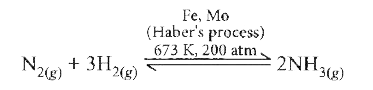
(iii) Due to this property dihydrogen is used for the manufacture of ammonia. (Haber.s process)
(ii) Due to this property hydrogen is used for the manufacture of vanaspati ghee from edible oils such as cotton-seed oil, soyabean oil, corn oil etc.
`"Unsaturated oil"+H_(2(g))overset("Ni catalyst")(to)"Saturated vanaspati ghee"`
(iii) Due to this property dihydrogen is used for the manufacture of ammonia. (Haber.s process)



Similar Questions
Explore conceptually related problems
Describe the industrial applications of hydrogen dependent on : a. the heat librated when its atoms are made to combine ont eh surface of a metal. b. its effect on unsaturated organic system in presence of a catalyst. c. its ability to combine with nitrogen under specific conditions.
Read the passage given below and answer the following questions: Reductive alkylation is the term applied to the process of introducing alkyl groups into ammonia or a primary or secondary amine by means of an aldehyde or ketone in the presence of a reducing agent. The present discussion is limited to those reductive alkylations in which the reducing agent is hydrogen and a catalyst or "nascent" hydrogen, usually from a metalacid combination, most of these reductive alkylations have been carried out with hydrogen and a catalyst. The principal variation excluded is that in which the reducing agent is formic acid or one of its derivatives, this modification is known as the Leuckart reaction. The process of reductive alkylation of ammonia consists in the addition of ammonia to a carbonyl compound and reduction of the addition compound or its dehydration product. The reaction usually is carried out in ethanol solution when the reduction is to be effected catalytically Since the primary amine is formed in the presence of the aldehyde it may react in the same way as ammonia, yielding an addition compound, a Schiff's base (RCH= NCH_(2)R) and finally, a secondary amine. Similarly, the primary amine may react with the imine, forming an addition product which also is reduced to a secondary amine Finally, the secondary amine may react with either the aldehyde or the imine to give products which are reduced to tertiary amines. Similar reactions may occur when the carbonyl compound employed is a ketone. (source: Emerson, W. S. (2011). The Preparation of Amines by Reductive Alkylation. Organic Reactions, 174–255. doi:10.1002/0471264180.or004.03 ) Acetaldehyde is reacted with ammonia followed by reduction in presence of hydrogen as a catalyst. The primary amine so formed further reacts with acetaldehyde. The Schiff’s base formed during the reaction is:
Read the passage given below and answer the following questions: Reductive alkylation is the term applied to the process of introducing alkyl groups into ammonia or a primary or secondary amine by means of an aldehyde or ketone in the presence of a reducing agent. The present discussion is limited to those reductive alkylations in which the reducing agent is hydrogen and a catalyst or "nascent" hydrogen, usually from a metalacid combination, most of these reductive alkylations have been carried out with hydrogen and a catalyst. The principal variation excluded is that in which the reducing agent is formic acid or one of its derivatives, this modification is known as the Leuckart reaction. The process of reductive alkylation of ammonia consists in the addition of ammonia to a carbonyl compound and reduction of the addition compound or its dehydration product. The reaction usually is carried out in ethanol solution when the reduction is to be effected catalytically Since the primary amine is formed in the presence of the aldehyde it may react in the same way as ammonia, yielding an addition compound, a Schiff's base (RCH= NCH_(2)R) and finally, a secondary amine. Similarly, the primary amine may react with the imine, forming an addition product which also is reduced to a secondary amine Finally, the secondary amine may react with either the aldehyde or the imine to give products which are reduced to tertiary amines. Similar reactions may occur when the carbonyl compound employed is a ketone. (source: Emerson, W. S. (2011). The Preparation of Amines by Reductive Alkylation. Organic Reactions, 174–255. doi:10.1002/0471264180.or004.03 ) Reductive alkylation of ammonia by means of an aldehyde in presence of hydrogen as reducing agents results in formation of:
Read the passage given below and answer the following questions: Reductive alkylation is the term applied to the process of introducing alkyl groups into ammonia or a primary or secondary amine by means of an aldehyde or ketone in the presence of a reducing agent. The present discussion is limited to those reductive alkylations in which the reducing agent is hydrogen and a catalyst or "nascent" hydrogen, usually from a metalacid combination, most of these reductive alkylations have been carried out with hydrogen and a catalyst. The principal variation excluded is that in which the reducing agent is formic acid or one of its derivatives, this modification is known as the Leuckart reaction. The process of reductive alkylation of ammonia consists in the addition of ammonia to a carbonyl compound and reduction of the addition compound or its dehydration product. The reaction usually is carried out in ethanol solution when the reduction is to be effected catalytically Since the primary amine is formed in the presence of the aldehyde it may react in the same way as ammonia, yielding an addition compound, a Schiff's base (RCH= NCH_(2)R) and finally, a secondary amine. Similarly, the primary amine may react with the imine, forming an addition product which also is reduced to a secondary amine Finally, the secondary amine may react with either the aldehyde or the imine to give products which are reduced to tertiary amines. Similar reactions may occur when the carbonyl compound employed is a ketone. (source: Emerson, W. S. (2011). The Preparation of Amines by Reductive Alkylation. Organic Reactions, 174–255. doi:10.1002/0471264180.or004.03 ) The reaction of ammonia and its derivatives with aldehydes is called:
Read the passage given below and answer the following questions: Reductive alkylation is the term applied to the process of introducing alkyl groups into ammonia or a primary or secondary amine by means of an aldehyde or ketone in the presence of a reducing agent. The present discussion is limited to those reductive alkylations in which the reducing agent is hydrogen and a catalyst or "nascent" hydrogen, usually from a metalacid combination, most of these reductive alkylations have been carried out with hydrogen and a catalyst. The principal variation excluded is that in which the reducing agent is formic acid or one of its derivatives, this modification is known as the Leuckart reaction. The process of reductive alkylation of ammonia consists in the addition of ammonia to a carbonyl compound and reduction of the addition compound or its dehydration product. The reaction usually is carried out in ethanol solution when the reduction is to be effected catalytically Since the primary amine is formed in the presence of the aldehyde it may react in the same way as ammonia, yielding an addition compound, a Schiff's base (RCH= NCH_(2)R) and finally, a secondary amine. Similarly, the primary amine may react with the imine, forming an addition product which also is reduced to a secondary amine Finally, the secondary amine may react with either the aldehyde or the imine to give products which are reduced to tertiary amines. Similar reactions may occur when the carbonyl compound employed is a ketone. (source: Emerson, W. S. (2011). The Preparation of Amines by Reductive Alkylation. Organic Reactions, 174–255. doi:10.1002/0471264180.or004.03 ) Ethanal on reaction with ammonia forms an imine (X) which on reaction with nascent hydrogen gives (Y). Identify ‘X’ and ‘Y’.
Read the passage given below and answer the following questions: Reductive alkylation is the term applied to the process of introducing alkyl groups into ammonia or a primary or secondary amine by means of an aldehyde or ketone in the presence of a reducing agent. The present discussion is limited to those reductive alkylations in which the reducing agent is hydrogen and a catalyst or "nascent" hydrogen, usually from a metalacid combination, most of these reductive alkylations have been carried out with hydrogen and a catalyst. The principal variation excluded is that in which the reducing agent is formic acid or one of its derivatives, this modification is known as the Leuckart reaction. The process of reductive alkylation of ammonia consists in the addition of ammonia to a carbonyl compound and reduction of the addition compound or its dehydration product. The reaction usually is carried out in ethanol solution when the reduction is to be effected catalytically Since the primary amine is formed in the presence of the aldehyde it may react in the same way as ammonia, yielding an addition compound, a Schiff's base (RCH= NCH_(2)R) and finally, a secondary amine. Similarly, the primary amine may react with the imine, forming an addition product which also is reduced to a secondary amine Finally, the secondary amine may react with either the aldehyde or the imine to give products which are reduced to tertiary amines. Similar reactions may occur when the carbonyl compound employed is a ketone. (source: Emerson, W. S. (2011). The Preparation of Amines by Reductive Alkylation. Organic Reactions, 174–255. doi:10.1002/0471264180.or004.03 ) (CH_(3)CH_(2)CH_(2))_(2)NH +CH_(3)CH_(2)CHO to P overset(2[H])to Q The ompound Q is :
Both alkali metals and alkaline earth metals are s- block elements. They resemble each other in many respects but still there are certain dissimilarities in their properties due to different number of electrons in the valence shell, different atomic radii, ionisation enthalpy, electronegativity, etc. Like lithium, Be also differs from rest of the alkaline earth metals on account of its small atomic size and high electronetativity. Be^(2+) ion is very small and exerts a high polarising effect on any anion associated with it. The alkaline earth metal which does no directly combine with hydrogen is
Recommended Questions
- Describe the industrial applications of hydrogen dependent on (i) th...
Text Solution
|
- Describe the industrial applications of hydrogen dependent on : a. the...
Text Solution
|
- Hydrogen readily combines with metals and thus show its
Text Solution
|
- एक संयक्त सूक्ष्मदर्शी का वर्णन करे एवं उसकी आवर्धन-क्षमता का व्यंजक ...
Text Solution
|
- Describe the industrial applications of hydrogen dependent on : a. th...
Text Solution
|
- Illustrate the industrial applications of hydrogen , depending on It...
Text Solution
|
- Illustrate the industrial applications of hydrogen , depending on Its ...
Text Solution
|
- Describe the industrial use of dihydrogen, which depends on its abilit...
Text Solution
|
- Hydrogen readily combines with metals and thus shown its :
Text Solution
|