DNA replication takes place during S-phase of interphase in cell cycle. DNA replication is semiconservative process. In this process
(i) The two strands of the parent DNA molecule separate.
(ii) Complementary strands are synthesised using old strands as template.
Each progeny strand has one old and one new strand
Requirement for DNA Replication
• DNA template .
• A primer (usually RNA)
• Deoxyribonucleotide triphosphate (i.e. ATP, dGTP, dTTP, dCTP)
• `Mg^(2+)`
• DNA unwindiwing proteins (helicase and gyrase).
• RNA polymerase to synthesise the RNA primer .
• DNA polymerase (a DNA synthesising enzyme )
DNA replication is bidirectional. A replicon is the segment of DNA which is capable to perform DNA replication and independent of other segments of DNA replication and independent of other segments of DNA . Each replicon has an origin of replication, at which DNA replication starts and a terminus, at which replication stops.
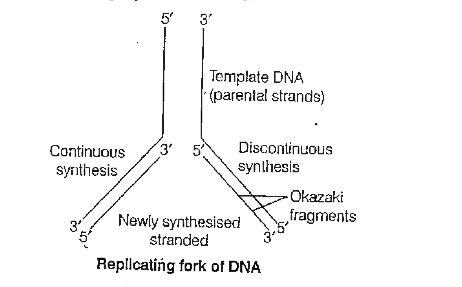
The two strand of DNA double helix unwind with the help of DNA unwinding proteins (e.g. DNA gyrase and DNA helicase) . Unwinding proteins produces two Y-shaped forks at origin, one fork is located at each end of the origin. When replication begins, these forks become replication forks.
The unwinding of the strands imposes by the action of a superhelix relaxing protein. Single Stand Binding Proteins (SSBPs) stabilise the unwound parental DNA Initiation of DNA synthesis requires an RNA primer. RNA primer is synthsised on DNA template by an enzyme primase
The free `3. to OH` of primer RNA provides the initiation point of DNA polymerase, which requires a free 3. - OH of a pre-existing polynucleotide for the initiation of DNA replication. DNA replication is semiconservative, semidiscontinuous , which occurs always in `5. to 3.` direction . Replication of `3. to 5.` strand of a DNA molecule proceeds continuously therefore , the `3. to 5.` strand of DNA molecule is known as leading strand. The replication of
`5. to 3.` strand of the DNA molecule is discontinuous and is known as lagging strand. Replication of lagging strand generates small nucleotide fragments in `5. to 3.` direction called Okazaki fragments.
After DNA replication, DNA content in a cell gets double. Thus, if cell division is not followed after replication then increased DNA/chromosome content will lead to polyploidy condition.


