

Home
Class 11
PHYSICS
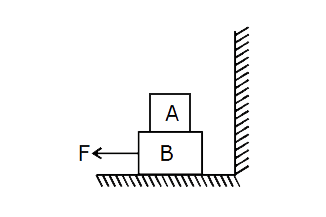
Block A weights 4 N and block B weights ...

Block A weights 4 N and block B weights 8 N. The coefficient of kinetic friction is 0.25 for all surfaces. The force F to slide B at a constant speed, when A rests on B and moves with it, is

Promotional Banner

Similar Questions

Explore conceptually related problems

Block A weighs 4 N and block weigh 8 N The coefficient of kinetic friction is 0.25 for all surface find the force F to slide B at a constant speed when (a) A rest on B and moves with it (b) A is held at rest and (c ) A and B are connected by a light cord passing over a smooth putting as shown in fig 7.31 (a - c) restively.

Block A as shown in figure weight 1.40 N and block B weight 4.20 N The coefficient of kinetic friction between all surface is 0.30 Find the magnitude of the horizontal force necessary to drag block B to the left at constant speed if A and B are connected by a light , fiexible cort passing around a fixed , frictionless pulled.

Block A in figure-2.207 weights 2.7N and block B weighs 5.4 N the coefficient of kinetic friction between all surfaces is 0.25. Find the magnitude of the horizontal force F necessary to drag blocks to the left at constant speed if A and B are connected by a light, flexible cord passing around a fixed frictionless pulley

Two blocks A & B are connected over a massless pulley as shown in figure.The mass of block A is 12 kg and the coefficient of kinetic friction between block A and fixed wedge is 0.5. Block A slides up the incline at constants speed. The mass of block B is?

Block A has a weight of 3000 N and block B has a weight of 50 N . Coefficient of friction for A is mu_(k) = 0.2 . Determine the pseed of block A after moves 1 m down the plane, starting from rest. Negelect the mass of the cord and pulleys.

A bullet of mass 0.01 kg is fired horizontal into a 4 kg wooden block block at rest , on a horizontal surface. The coefficient of kinetic friction between the block and surface is 0.25 the combination moves 20 m before coming to rest . With what speed did the bullet strike the block ?

Block A in figure weights 90 N. The coefficient of static friction between the block and the surface on which it rests is 0.3. The weight w is 15N, and the system is in equilibrium. Find the friction force exerted on block A.(b) Find the maximum weight w for which the system will remain in equilibrium.

Block A of weight 500 N and block B of weight 700 N are connected by rope pulley system as shown. The largest weight C that can be suspended without moving block A and B is W . The coefficient of friction for all plane surfaces of contact is 0.3 . The pulleys are ideal. Find (W)/(90) .

A block weighing 20 N rests on a horizontal surface. The: coefficient of static friction between block and surface is 0.40 and the coefficient of kinetic friction is 0.20. ( a) How large is the friction force exerted on the block? (b) How great will the friction force be if a horizontal force of 5 N is exerted on the block? (c) What is the minimum force that will start the block in motion? (d) What is the minimum force that will keep the block in motion once it has been started? (e) If the horizontal force is 10 N, what is the friction force?

In the figure, a block of weight 60N is placed on a rough surface. The coefficient of friction between the block and the surface is 0.5 . What should be the weight W such that the block does not slip on the surface?