Home
Class 12
PHYSICS
State Biot-Savart.s law. Derive an expre...

State Biot-Savart.s law. Derive an expression for magnetic field at a point near an infinitely long and straight current carrying conductor.

Text Solution

Verified by Experts
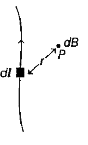
Biot-Savart.s law states that the magnetic field at any point P at a distance r from a current carrying element is directly proportional to the current element (Idl) `sintheta` and inversely proportional to the square of distance between point P and current element.

i.e. `dBpropIdlsinthetaanddBprop(1)/(r^(2))`
`implies dBprop(Idlsintheta)/(r^(2))`
`implies dB=(mu_(0))/(4pi).(Idlsintheta)/(r^(2))`
Magnetic field due to infinite straight current carrying conductor
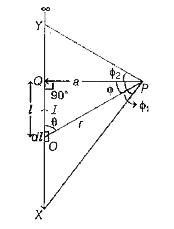
Consider a straight conductor XY carrying current I. We wish to find magnetic field at point P whose perpendicular distance from the wire is `PQ=a`.
Consider a small current element dl of the conductor at point O. Its distance from Q is `OQ=l`.
Let r be the position vector of point P relative to the current element and `theta` be the angle between dl and r.
Now according to Biot-Savart.s law,
`dB=(mu_(0))/(4pi).(Idlsintheta)/(r^(2))`

From right `DeltaOQP, theta+phi=90^(@)`
`implies theta=90^(@)-phi`
`sintheta=sin(90^(@)-phi)=cosphi`
`cosphi=(alpha)/(r )`
`implies r=(alpha)/(cosphi)=alphasecphi`
`tanphi=(l)/(alpha)impliesl=atanphi`
On differentiating, we get `dl=asec^(2)phidphi`
`dB=(mu_(0))/(4pi)(I(alphasec^(2)phidphi)cosphi)/(alpha^(2)sec^(2)phi)`
`implies dB=(mu_(0)I)/(4pialpha)cosphidphi`
On integrating above relation within the limits - `phi_(1) and phi_(2)`
`B=int_(-phi_(1))^(phi_(2))dB=(mu_(0)I)/(4pialpha)int_(-phi_(1))^(phi_(2))cosphidphi`
`=(mu_(0)I)/(4pialpha)(sinphi)_(-phi_(1))^(phi_(2))`
`=(mu_(0)I)/(4pialpha)(sinalpha_(2)+sinphi_(1))`
Promotional Banner

Similar Questions

Explore conceptually related problems

The shape of the magnetic lines of force due to an infinite, long, straight current carrying conductor is

State Biot-Savart's law. Then using this law derive an expression for magnetic field intensity due to a circular coil at a point on its centre.