Home
Class 12
CHEMISTRY
Imidazole (at right) has two nitrogens, ...

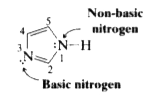
Imidazole (at right) has two nitrogens, N3 is relatively basic (like the nitroge of pyridine). N1 is relatively non-basic (like the nitrogen of pyrrole). Explain the different basicities of these two nitrogens.

Text Solution

Verified by Experts
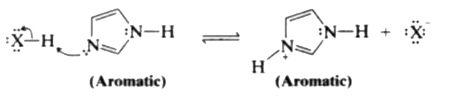
When imidazole accepts a proton at N3 the electron pair that accepts the proton is not a part of the `pi` system of six electrons that makes imidazole aromatic. Consequently, the conjugate base that is formed is still aromatic (it is an aromatic cation) and retains its resonance energy of stabilization.

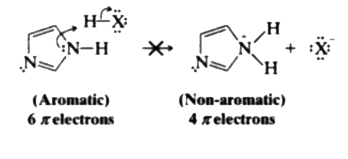
On the other hand, if imidazole were to accept a proton at N1 the resulting ion (which is not formed) would not be aromatic and would have much greater potential energy (its resonance stabilization would be lost). Hence, N1 is not appreciably basic.
Promotional Banner

Topper's Solved these Questions

  • AROMATIC COMPOUNDS

    MS CHOUHAN|Exercise Additional Objective Questions (Single Correct Choice Type)|20 Videos
  • AROMATIC COMPOUNDS

    MS CHOUHAN|Exercise Additional Objective Questions (Linked Comprehension Type)|6 Videos
  • AROMATIC COMPOUNDS

    MS CHOUHAN|Exercise Subjective Problems|3 Videos
  • AN INTRODUCTION TO ORGANIC REACTIONS AND THEIR MECHANISMS ACIDS AND BASES

    MS CHOUHAN|Exercise ADDITIONAL QUESTION (SINGLE CORRECT CHOICE TYPE )|32 Videos
  • BIOMOLECULES

    MS CHOUHAN|Exercise Level 2|1 Videos

Similar Questions

Explore conceptually related problems

Nitrogen (N_(2)) is relatively unreactive, because

A: Pyrrole is less basic than pyridine. R: Lone pair electron of nitrogen in pyrrole participate in conjugation to gain aromatic character.

Amines are basic compounds They act as Lewis base due to the presence of lone pair electrons at nitrogen Amines also behave as base as well as Bronsted inductive effect, steric hindrance and resosnance. CH_(3)-NH_(2)+HOH hArr CH_(3)-NH_(3)^(+)+OH^(-) CH_(3)-NH_(2)+H^(+)Cl^(-)hArr CH_(3)-NH_(3)^(+)+Cl^(-) Alkyl groups and electron groups hence these groups increases the electron density at nitrogen as well as the basic amines character of amines. Basic character of teritary amines is reduced due to the steric hindrance of three alkyl groups. Experimentally it is observed that stronger bases have smaller values of pK_(b) greater value of K_(b) . Which among the following is the most basic in aqueous medium?

Amines are basic compounds They act as Lewis base due to the presence of lone pair electrons at nitrogen Amines aho behave as base as well as Bronsted inductive effect, steric hindrance and resosnance. CH_(3)-NH_(2)+HOH hArr CH_(3)-NH_(3)^(+)+OH^(-) CH_(3)-NH_(2)+H^(+)Cl^(-)hArr CH_(3)-NH_(3)^(+)+Cl^(-) Alkyl groups and electron groups hence these groups increases the electron density at nitrogen as well as the basic amines character of amines. Basic character of teritary amines is reduced due to the steric hindrance of three alkyl groups. Experimentally it is observed that stronger bases have smaller values of pK_(b) greater value of K_(b) . Which among hte following is the most basic in aqueous medium?

Amines are basic compounds They act as Lewis base due to the presence of lone pair electrons at nitrogen Amines aho behave as base as well as Bronsted inductive effect, steric hindrance and resosnance. CH_(3)-NH_(2)+HOH hArr CH_(3)-NH_(3)^(+)+OH^(-) CH_(3)-NH_(2)+H^(+)Cl^(-)hArr CH_(3)-NH_(3)^(+)+Cl^(-) Alkyl groups and electron groups hence these groups increases the electron density at nitrogen as well as the basic amines character of amines. Basic character of teritary amines is reduced due to the steric hindrance of three alkyl groups. Experimentally it is observed that stronger bases have smaller values of pK_(b) greater value of K_(b) . Which of the following is the most basic?

(A) Pyrrole is more basic than pyridine. (R) In pyrrole, nitrogen is sp^(2) -hybridized.

MS CHOUHAN-AROMATIC COMPOUNDS-Solved Problem
  1. Provide a name for each of the following compounds.

    Text Solution

    |

  2. Using the polygon-and-circle method to outline the molecular orbitals ...

    Text Solution

    |

  3. Imidazole (at right) has two nitrogens, N3 is relatively basic (like t...

    Text Solution

    |

  4. Designate whether each of the following compounds is aromatic, non-aro...

    Text Solution

    |

  5. Designate whether each of the following compounds is aromatic, non-aro...

    Text Solution

    |

  6. Designate whether each of the following compounds is aromatic, non-aro...

    Text Solution

    |

  7. Designate whether each of the following compounds is aromatic, non-aro...

    Text Solution

    |

  8. Designate whether each of the following compounds is aromatic, non-aro...

    Text Solution

    |

  9. Designate whether each of the following compounds is aromatic, non-aro...

    Text Solution

    |

  10. Designate whether each of the following compounds is aromatic, non-aro...

    Text Solution

    |

  11. Designate whether each of the following compounds is aromatic, non-aro...

    Text Solution

    |

  12. Designate whether each of the following compounds is aromatic, non-aro...

    Text Solution

    |

  13. In the given compound, will Br ionize in the form of (a) Br^(-) or (b)...

    Text Solution

    |

  14. The given compound has high dipole moment. Explain.

    Text Solution

    |

  15. Explain why the given compound undergoes dimerization at room temperat...

    Text Solution

    |

  16. Compare the rate of reaction of the following compounds with AgNO(3).

    Text Solution

    |

  17. Classify each as aromatic, anti-aromatic and non-aromatic compound.

    Text Solution

    |

  18. Classify each as aromatic, anti-aromatic and non-aromatic compound.

    Text Solution

    |

  19. Classify each as aromatic, anti-aromatic and non-aromatic compound.

    Text Solution

    |

  20. Classify each as aromatic, anti-aromatic and non-aromatic compound.

    Text Solution

    |