Home
Class 12
BIOLOGY
Go through the following diagram of two ...

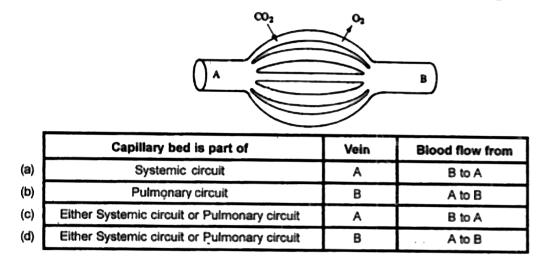
Go through the following diagram of two mammalian blood vessels (A and B) connected by a capillary bed. Blood pressure is higher in B than in A. The arrows indicate the direction of net diffusion for `O_(2) and CO_(2)`.

Text Solution

Verified by Experts

The correct Answer is:

A
Promotional Banner

Similar Questions

Explore conceptually related problems

A liquid flows through two capillary tubes A and B connected in series. The length and radius of B are twice that of A. What is the ratio of the pressure difference across A to that across B ?

The human ciculatory system can be thought of as a closed system of interconnecting pipes through which fluid is continuously circulated by two pumps the two pumps the right and left verticles of the heart, work as simple two-stroke force pumps. The muscles of the heart regulate the force by contracting and relaxing. the contraction (systole) lasts about 0.2s and a complete systole/diastole (contraction/relaxation) cycle lasts about 0.8s. For flood pressures and speeds in the normal range. the volume flow rate of blood through a blood vessel is directly proportional tot he pressure difference over a length of the vessel and to the fourth power of the radius of the vessel. The total mechanical energy per unit volume of blood just as it leaves the heart is E//V=rhogh+P+rhov^(2) Q. Which of the following is a way to achieve approximately a 45% increase in the volume flow rate of blood through a blood vessel?

What are the function of the conducting pan the respiratory system? a. Transportation of the atmospheric air to the alveoli b. Clears atmospheric air from foreign particles c. Humidifles atmospheric air d. Brings the atmospheric air to body temperature e. Diffusion of O_(2)" and "CO_(2) between blood and atmospheric air

The human ciculatory system can be thought of as a closed system of interconnecting pipes through which fluid is continuously circulated by two pumps the two pumps the right and left verticles of the heart, work as simple two-stroke force pumps. The muscles of the heart regulate the force by contracting and relaxing. the contraction (systole) lasts about 0.2s and a complete systole/diastole (contraction/relaxation) cycle lasts about 0.8s. For flood pressures and speeds in the normal range. the volume flow rate of blood through a blood vessel is directly proportional tot he pressure difference over a length of the vessel and to the fourth power of the radius of the vessel. The total mechanical energy per unit volume of blood just as it leaves the heart is E//V=rhogh+P+rhov^(2) Q. Why is diastolic blood pressure muchh lower than systolic pressure?

Read the following statement having two blanks (A and B).The optic nerves the eye and the retinal blood vessels enter it at a point _(A)_ to and slightly _(B)_the posterior pole of the eye ball. The one correct option for the two blanks is :

Which is the correct sequence of steps in respiration? a. Transport of gases by the blood b. Breathing or pulmonary ventilation c. Cellular respiration d. Diffusion of O_(2)" and CO_(2) between blood and tissues e . Diffusion of = O_(2)" and "CO_(2) across alveolar membrane
