Home
Class 12
PHYSICS
A screen is at distance D = 80 cm form a...

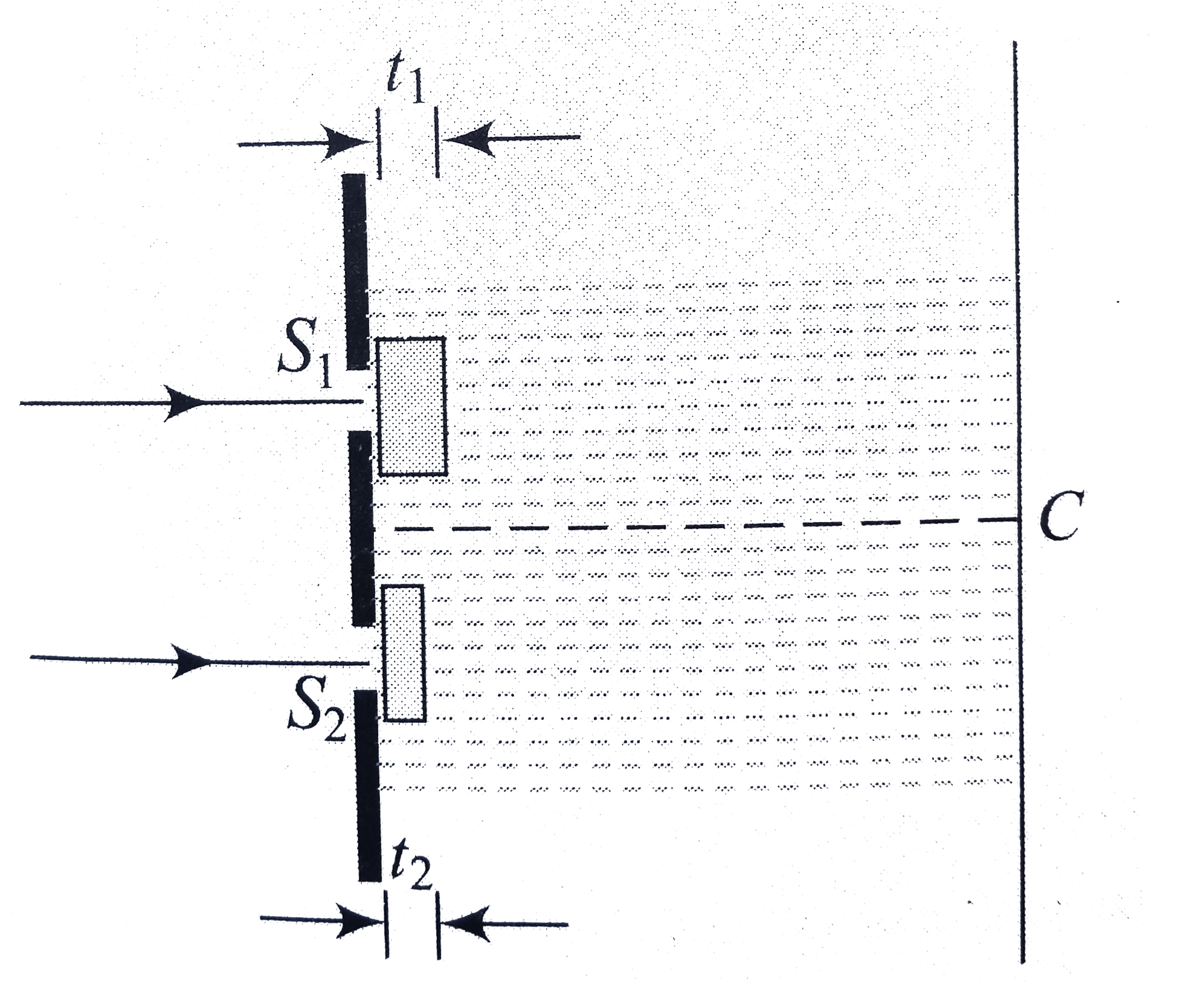
A screen is at distance `D = 80` cm form a diaphragm having two narrow slits `S_(1)` and `S_(2)` which are `d = 2` mm apart.
Slit `S_(1)` is covered by a transparent sheet of thickness
`t_(1) = 2.5 mu m` slit `S_(2)` is covered by another sheet of thickness
`t_(2) = 1.25 mu m` as shown if Fig. 2.52.
Both sheets are made of same material having refractive index `mu = 1.40`
Water is filled in the space between diaphragm and screen. A monochromatic light beam of wavelength `lambda = 5000 Å` is incident normally on the diaphragm.
Assuming intensity of beam to be uniform, calculate ratio of intensity of C to maximum intensity of interference pattern obtained on the screen `(mu_(w) = 4//3)`

A

`3/4`

B

`1/2`

C

`1/3`

D

`3/5`

Text Solution

Verified by Experts

The correct Answer is:

A
Promotional Banner

Similar Questions

Explore conceptually related problems

Monochromatic light of wavelenghth 600 nm is used in a Young's double sllt experiment. One of the slits is covered by a transparent sheet of thickness 1.8xx10^-5 m made of a material of refractive index 1.6. How many fringe will shift due to the introduction of the sheet?

Two slits S_(1) and S_(2) illuminated by a white light source give a white central maxima. A transparent sheet of refractive index 1.25 and thickness t_(1) is placed in front of S_(1) . Another transparent sheet of refractive index 1.50 and thickness t_(2) is placed in front of S_(2) . If central maxima is not effected, then ratio of the thickness of the two sheets will be :

In young's double slit experiment, distance between the slit S_1 and S_2 is d and the distance between slit and screen is D . Then longest wavelength that will be missing on the screen in front of S_1 is

A very thin sheet of plastic having refractive index mu=1.5 covers one slit of a double slit apparatus illuminated by 700 nm light . The central point on the screen , instead of being maximum , is dark . What is the possible thickness of the plastic in (nm) ?

A monochromatic beam of bright of light of wavelength 5000 Å is used in Young's double slit experiment. If one of the slits is covered by a transparent sheet of thikness 1.4 xx 10^(-5) m , having refractive index of its medium 1.25. Then the number of fringes shifted is

In Yonung's double-slit experiment, two slits which are separated by 1.2 mm are illuminated with a monochromatic light of wavelength 6000 Å The interference pattern is observed on a screen placed at a distance of 1 m from the slits. Find the number of bright fringes formed over 1 cm width on the screen.

In the YDSE shown the two slits are covered with thin sheets having thickness t & 2t and refractive index 2mu and mu .Find the position (y) of central maxima.

Figure shows a YDSE setup having identical slits S_(1) and S_(2) with d =5 mm and D = 1 m. A monochromatic light of wavelength lamda = 6000 Å is incident on the plane of slit due to which at screen centre O, an intensity I_(0) is produced with fringe pattern on both sides Now a thin transparent film of 11 mu m thickness and refractive index mu = 2.1 is placed in front of slit S_(1) and now interference patten is observed again on screen. After placing the film of slit S_(1) , the intensity at point O screen is :

Figure shows a YDSE setup having identical slits S_(1) and S_(2) with d =5 mm and D = 1 m. A monochromatic light of wavelength lamda = 6000 Å is incident on the plane of slit due to which at screen centre O, an intensity I_(0) is produced with fringe pattern on both sides Now a thin transparent film of 11 mu m thickness and refractive index mu = 2.1 is placed in front of slit S_(1) and now interference patten is observed again on screen. After placing the film of slit S_(1) , the intensity at point O screen is :

YDSE is carried with two thin sheets of thickness 10.4 mu m each and refractive index mu_1 = 1.52 and mu_2 = 1.40 covering the slits S_1 and S_2 respectively. If white light of range 400nm to 780 nm is used, then which wavelength will form maxima exactly at point O, the centre of the screen
