Home
Class 12
PHYSICS
A ring shaped tube contain two ideal gas...

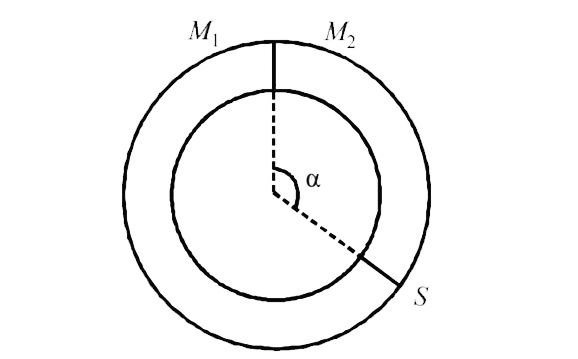
A ring shaped tube contain two ideal gases with equal masses and molar masses `M_1=32 and M_2=28.`
The gases are separated by one fixed partition P and another movable stopper S which can move freely without friction inside the ring. The angle `alpha` as shown in the figure is ...... degrees.

A

`182^(@)`

B

`170^(@)`

C

`192^(@)`

D

`180^(@)`

Text Solution

Verified by Experts

The correct Answer is:

C
Promotional Banner

Similar Questions

Explore conceptually related problems

Two blocks of masses m_(1) and m_(2) are connected by a string of negligible mass which pass over a frictionless pulley fixed on the top of an inclined plane as shown in figure. The coefficient of friction between m_(1) and plane is mu .

An ideal monoatomic gas is enclosed in a fixed horizontal adiabatic cylinder of cross sectional area A. The cylinder is fitted with an adiabatic piston of mass m (attached to one end of a spring as shown) which can move horizontally without friction inside the cylinder. In equilibrium, the spring is in natural length and pressure and volume are P_0 and V_0 respectively. The piston is slightly displaced from equilibrium and released. Then, frequency of small oscillation is

Two identical vessels A and B contain masses m and 2m of same gas. The gases in the vessels are heated keeping their volumes constant and equal. The temperature-pressure curve for mass 2m makes angle alpha with T-axis and that and for mass m makes an angle beta with T-axis then

One end a light spring of natural length d and spring constant k ( = mg //d) is fixed on a rigid support and the other end is fixed to a smoth ring of mass m which can slide without friction on a vertical rod fixed at a distance d from the support. Initially , the spring makes an angle of 37^(@) with the horizontal as shown in the figure. The system is released from rest. The speed of the ring at the same angle subtended downward will be

Two spherical balls of masses m_1 and m_2 collide as shown in figure. After collision mass m_1 moves with velocity u/3 in a direction perpendicular to original direction. The angle theta at which mass m_2 will move after collision is

A bead of mass m can slide without friction on a fixed circular horizontal ring of radius 3R having a centre at the point C. The bead is attached to one of the ends of spring of spring constant k. Natural length of spring is R and the other end of the spring is R and the other end of the spring is fixed at point O as shown in the figure. If the bead is released from position A, then the kinetic energy of the bead when it reaches point B is

One end of a light spring of natural length 4m and spring constant 170 N/m is fixed on a rigid wall and the other is fixed to a smooth ring of mass (1)/(2) kg which can slide without friction in a verical rod fixed at a distance 4 m from the wall. Initially the spring makes an angle of 37^(@) with the horizontal as shown in figure. When the system is released from rest, find the speed of the ring when the spring becomes horizontal.

A ring of mass M and radius R is rotating with angular speed omega about a fixed vertical axis passing through its centre O with two point masses each of mass (M)/(8) at rest at O. These masses can move radially outwards along two massless rods fixed on the ring as shown in the figure. At some instant the angular speed of the system is (8)/(9) omega and one fo the masses is at a distance of (3)/(5) R from O. At this instant the distance of the other mass from O is

Two spherical balls of masses m1 and m2 collide as shown in figure. After collision mass m1 moves with velocity u/3 in a direction perpendicular to original direction. The angle theta at which mass m2 will move after collision is

On end of a light spring of natural length d and spring constant k is fixed on a rigid wall and the other is attached to a smooth ring of mass m which can slide without friction on a vertical rod fixed at a distance d from the wall. Initially the spring makes an angle of 37^@ with the horizontal. as shown in figure. When the system is released from rest, find the speed of the ring when the spring becomes horizontal. (sin 37^@=3/5) .
