A solid metallic cuboid of homogeneous material having geometrical dimension as shown in the figure will have a ratio of resistances for the sense of current along x, y and z directions respectively, equal to
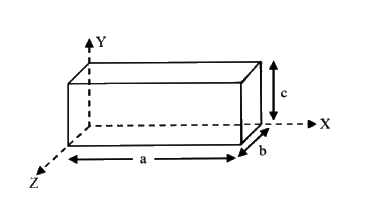
A solid metallic cuboid of homogeneous material having geometrical dimension as shown in the figure will have a ratio of resistances for the sense of current along x, y and z directions respectively, equal to
A
`a:b:c`
B
`a:c:b`
C
`a^(2):b^(2):c^(2)`
D
`a^(2):c^(2):b^(2)`
Text Solution
Verified by Experts
The correct Answer is:
D



Similar Questions
Explore conceptually related problems
Two wires of the same materical having equal area of cross-section have L and 2L. Their respective resistances are in the ratio
In the circuit shown in figure, all wires have equal resistance r . Find the equivalent resistance between A and B
In a thin rectangular metallic strip a constant current I flows along the positive x-direction , as shown in the figure. The length , width and thickness of the strip are l, w and d , respectively. A uniform magnetic field vec(B) is applied on the strip along the positive y- direction . Due to this, the charge carriers experience a net deflection along the z- direction . This results in accumulation of charge carriers on the surface PQRS ansd apperance of equal and opposite charges on the face opposite to PQRS . A potential difference along the z-direction is thus developed. Charge accumulation contiues untill the magnetic force is balanced by the electric force. The current is assumed to be uniformly distributed on the cross- section of the strip and carried by electrons. Consider two different metallic strips (1 and 2) of the same material . Their lengths are the same,widths are w_(1) and w_(2) and thickness are d_(1) and d_(2) respectively. Two points K and M are symmetrically located on the opposite faces parallel to the x-y plane ( see figure) . V_(1) and V_(2) are the potential differences between K and M in strips 1 and 2 , respectively . Then, for a given current I flowing through them in a given magnetic field strength B , the correct statement(s) is (are)
In a thin rectangular metallic strip a constant current I flows along the positive x-direction , as shown in the figure. The length , width and thickness of the strip are l, w and d , respectively. A uniform magnetic field vec(B) is applied on the strip along the positive y- direction . Due to this, the charge carriers experience a net deflection along the z- direction . This results in accumulation of charge carriers on the surface PQRS ansd apperance of equal and opposite charges on the face opposite to PQRS . A potential difference along the z-direction is thus developed. Charge accumulation contiues untill the magnetic force is balanced by the electric force. The current is assumed to be uniformly distributed on the cross- section of the strip and carried by electrons. Consider two different metallic strips (1 and 2) of the same material . Their lengths are the same,widths are w_(1) and w_(2) and thickness are d_(1) and d_(2) respectively. Two points K and M are symmetrically located on the opposite faces parallel to the x-y plane ( see figure) . V_(1) and V_(2) are the potential differences between K and M in strips 1 and 2 , respectively . Then, for a given current I flowing through them in a given magnetic field strength B , the correct statement(s) is (are)
In a thin rectangular metallic strip a constant current I flows along the positive x -direction , as shown in the figure. The length , width and thickness of the strip are l, w and d , respectively. A uniform magnetic field vec(B) is applied on the strip along the positive y- direction . Due to this, the charge carriers experience a net deflection along the z- direction . This results in accumulation of charge carriers on the surface PQRS ansd apperance of equal and opposite charges on the face opposite to PQRS . A potential difference along the z-direction is thus developed. Charge accumulation contiues untill the magnetic force is balanced by the electric force. The current is assumed to be uniformly distributed on the cross- section of the strip and carried by electrons. Consider two different metallic strips (1 and 2) of same dimensions n_(1) and n_(2) , repectrively . Strip 1 is placed in magnetic field B_(1) and strip 2 is placed in magnetic field B_(2) , both along positive y- directions . Then V_(1) and V_(2) are the potential differences developed between K and M in strips 1 and 2 , respectively . Assuming that the current I is the same for both the strips, the correct option(s) is (are)
In a thin rectangular metallic strip a constant current I flows along the positive x -direction , as shown in the figure. The length , width and thickness of the strip are l, w and d , respectively. A uniform magnetic field vec(B) is applied on the strip along the positive y- direction . Due to this, the charge carriers experience a net deflection along the z- direction . This results in accumulation of charge carriers on the surface PQRS ansd apperance of equal and opposite charges on the face opposite to PQRS . A potential difference along the z-direction is thus developed. Charge accumulation contiues untill the magnetic force is balanced by the electric force. The current is assumed to be uniformly distributed on the cross- section of the strip and carried by electrons. Consider two different metallic strips (1 and 2) of same dimensions n_(1) and n_(2) , repectrively . Strip 1 is placed in magnetic field B_(1) and strip 2 is placed in magnetic field B_(2) , both along positive y- directions . Then V_(1) and V_(2) are the potential differences developed between K and M in strips 1 and 2 , respectively . Assuming that the current I is the same for both the strips, the correct option(s) is (are)
A particle is projected in air at some angle to the horizontal, moves along parabola as shown in figure where x and y indicate horizontal and vertical directions, respectively . Shown in the diagram, direction of velocity and acceleration at points A, B and C.
A solid hemispherical uniformly charged body having charge Q is kept symmetrically along the y -axis as shown in the figure. The net electric field at ( d , 0 , 0 ) is
Which will have the maximum value of electron affinity O^(x),O^(y),O^(z) [x,y and z respectively are 0,-1 and -2] ?
Find the equation of plane having intercepts 3, 4, 5 on x, y, z axes respectively.
Recommended Questions
- A solid metallic cuboid of homogeneous material having geometrical dim...
Text Solution
|
- In the formula X = 3YZ^(2),X and Z have dimensions of capacitance and ...
Text Solution
|
- In the formula X = 3YZ^(2),X and Z have dimensions of capacitance and ...
Text Solution
|
- A long wire is along x = 0, z = d and carries current in positive y di...
Text Solution
|
- In series, potential difference distributes in direct ratio of resista...
Text Solution
|
- In the formula X=3YZ^2, X and Z have dimeniosn of capacitance and magn...
Text Solution
|
- A solid metallic cuboid of homogeneous material having geometrical dim...
Text Solution
|
- Two metallic wires. A and B of equal dimensions but made of different ...
Text Solution
|
- In the formula X=3YZ^(2),X and Z have the dimensions of capacitance an...
Text Solution
|