Home
Class 12
PHYSICS
A light ray moving in medium-I (of refra...

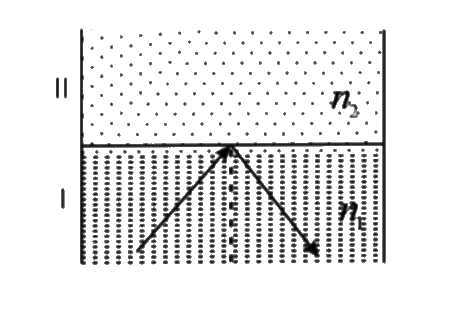
A light ray moving in medium-I (of refractive index `n_(1)`) is incident on interface of two media and it is totally internally reflected at the interface. Now, refractive index `n_(2)` of medium-II is decreased, then

A

ray will move completely parallel to the interface

B

ray will be still totally internally reflected at interface

C

ray will be totally transmitted into medium-II only, if angle of incidence is increased

D

ray will be totally transmitted in medium-II

Text Solution

Verified by Experts

The correct Answer is:

B
Promotional Banner

Similar Questions

Explore conceptually related problems

A ray of light, travelling in a medium of refractive index 'mu_, is incident at an angle i on a composite transparent plate consisting of three plates of refractive indices mu_1,mu_2 and mu_3. The ray emerges from the composite plate into a medium of refractive index mu_4, at angle x. Then,

In the diagram shown, light is incident on the interface between media 1 (refractive index n_(1) ) and 2 (refractive index n_(2) ) at angle slightly greater than the critical angle, and is totally reflected. The light is then also totally reflected at the interface between media 1 and 3 (refractive index n_(3) ), after which it travels in a direction opposite to its initial direction, The media must have a refractive indices such that. .

A light ray is incident perpendicularly to one face of a 90^circ prism and is totally internally reflected at the glass-air interface. If the angle of reflection is 45^circ , we conclude that the refractive index n

For total internal reflection to take place, the angle of incidence i and the refractive index mu of the medium must satisfy the inequality

Under what conditions is the phenomenon of total internal reflection between the critical angle of incidence and the refractive index of the medium.

Light guidance in an optical fibre can be understood by considering a structure comprising of thin solid glass cylinder of refractive index n_1 surrounded by a medium of lower refractive index n_2 . The light guidance in the structure takes place due to successive total internal reflectrions at the interface of the media n_1 and n_2 as shown in the fugure. All rays with the angle of incidence i less than a particular value i_m are confined in the medium of refractive index n_1 . The numerical aprture (NA) of the structure is defined as sini_m For two structure namely S_1 with n_1=(sqrt45)/(4) and n_2=(3)/(2) , and S_2 with n_1=(8)/(5) and n_2=(7)/(5) and taking the refractive index of water to be (4)/(3) and that of air to be 1, the correct option (s) is (are) ?

A cubical block of glass of refractive index n_1 is in contact with the surface of water of refractive index n_2. A beam of light is incident on vertical face of the block. After refraction a total internal reflection at the base and refraction at the opposite face take place. The ray emerges at angle theta as shown. The value of theta is given by

The angle of incidence at which reflected light is totally polarized for reflection from air to glass (refractive index n),

The angle of incidence at which reflected light is totally polarized for reflection from air to glass (refractive index n),

Light guidance in an optical fibre can be understood by considering a structure comprising of thin solid glass cylinder of refractive index n_1 surrounded by a medium of lower refractive index n_2 . The light guidance in the structure takes place due to successive total internal reflectrions at the interface of the media n_1 and n_2 as shown in the fugure. All rays with the angle of incidence i less than a particular value i_m are confined in the medium of refractive index n_1 . The numerical aprture (NA) of the structure is defined as sini_m If two structure of same cross-sectional area, but different numerical apertures NA_1 and NA_2(NA_2ltNA_1) are joined longitudinally, the numerical aperture of the combined structure is
