Home
Class 12
PHYSICS
Two ends of a conducting rod of varying ...

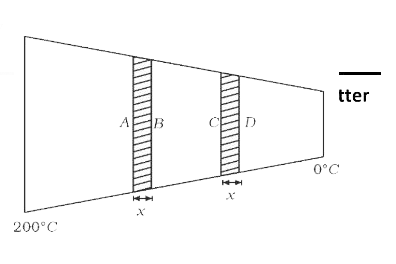
Two ends of a conducting rod of varying cross-section are maintained at `200^(@)Cand0^(@)C` respectively. In steady state :

A

temperature difference across AB and CD are equal

B

temperature difference across AB and CD are equal

C

temperature difference across AB is greater than that of across CD

D

temperature difference across AB is less than that of across CD

Text Solution

Verified by Experts

The correct Answer is:

C
Promotional Banner

Similar Questions

Explore conceptually related problems

Two ends of a conducting rod of varying cross-section are maintained at 200^(@)C and 0^(@)C respectively. In steady state:

Two rods of similar area of cross section and length are joined as shown in the figure. The ratio of their thermal conductivity is 2:3. The free ends are maintained at 100^(@)C and 0^(@)C respectivley. THE temperature at junction in steady state is

The ends of a copper rod of length 1m and area of cross-section 1cm^2 are maintained at 0^@C and 100^@C . At the centre of the rod there is a source of heat of power 25 W. Calculate the temperature gradient in the two halves of the rod in steady state. Thermal conductivity of copper is 400 Wm^-1 K^-1 .

The ends of a copper rod of length 1m and area of cross-section 1cm^2 are maintained at 0^@C and 100^@C . At the centre of the rod there is a source of heat of power 25 W. Calculate the temperature gradient in the two halves of the rod in steady state. Thermal conductivity of copper is 400 Wm^-1 K^-1 .

Assume that the thermal conductivity of copper is twice that of aluminium and four times that of brass. Three metal rods made of copper, aluminium and brass are each 15 cm long and 2 cm in diameter. These rods are placed end to end, with aluminium between the other two. The free ends of the copper and brass rods are maintained at 100^@C and 0^@C respectively. The system is allowed to reach the steady state condition. Assume there is no loss of heat anywhere. When steady state condition is reached everywhere, which of the following statement is true?

Assume that the thermal conductivity of copper is twice that of aluminium and four times that of brass. Three metal rods made of copper, aluminium and brass are each 15 cm long and 2 cm in diameter. These rods are placed end to end, with aluminium between the other two. The free ends of the copper and brass rods are maintained at 100^@C and 0^@C respectively. The system is allowed to reach the steady state condition. Assume there is no loss of heat anywhere. When steady state condition is reached everywhere, which of the following statement is true?

The ends of copper rod of length 1m and area of cross section 1cm^(2) are maintained at 0^(@)C and 100^(@)C . At the centre of rod, there is a source of heat of 32W . The thermal conductivity of copper is 400W//mK

Two rods of same dimensions, but made of different materials are joined end to end to end with their free end being maintained at 100^(@)C and 0^(@)C respectively. The temperature of the junction is 70^(@)C . Then the temperature of the junction if the rods are inerchanged will be equal to T^(@)C Find T :

A copper rod of length 75 cm and an iron rod of length 125cm are joined together end to end . Both are of circular cross section with diameter 2 cm . The free ends of the copper and iron are maintained at 100^@C and 0^@C respectively . The surface of the bars are insulated thermally . The temperature of the copper -iron junction is [Thermal conductivity of the copper is 386.4 W//m-K and that of iron is 48.46W//m-K ].

In the figure ABC is a conducting rod whose lateral surfaces are insulated. The length of the section AB is one-half of that of BC, and the respective thermal conductivities of the two sections are as given in the figure. If the ends A and C are maintained at 0^(@)C and 70^(@)C respectively, the temperature of junction B in the steady state is
