Home
Class 12
PHYSICS
The displacement (s)- velocity ( v ) gra...

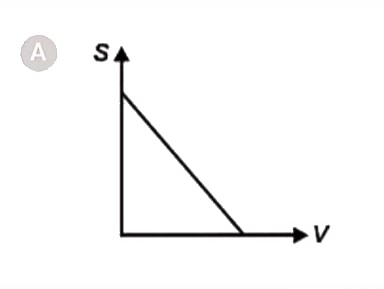
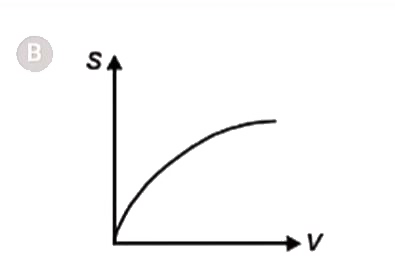
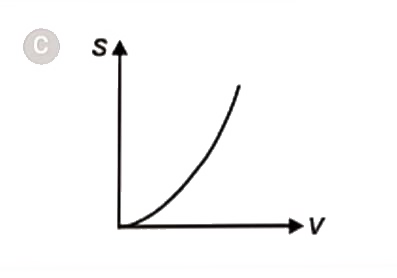
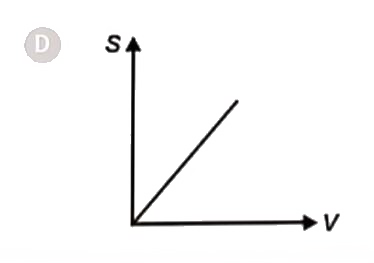
The displacement (s)- velocity ( v ) graph of a particle if it starts moving from rest with a uniform acceleration which is parallel to its instantaneous direction of motion is

A

B

C

D

Text Solution

AI Generated Solution

The correct Answer is:

To solve the problem of determining the displacement (s) - velocity (v) graph of a particle that starts moving from rest with uniform acceleration parallel to its instantaneous direction of motion, we can follow these steps: ### Step-by-Step Solution: 1. **Understanding Initial Conditions**: - The particle starts from rest, which means at time \( t = 0 \), the initial velocity \( v_0 = 0 \) and the initial displacement \( s_0 = 0 \). 2. **Using the Equation of Motion**: - Since the particle is moving with uniform acceleration \( a \), the equations of motion can be applied. The velocity \( v \) at any time \( t \) can be expressed as: \[ v = u + at \] where \( u = 0 \) (initial velocity). Thus, we have: \[ v = at \] 3. **Relating Displacement and Velocity**: - The displacement \( s \) can be expressed as: \[ s = ut + \frac{1}{2} a t^2 \] Again, since \( u = 0 \): \[ s = \frac{1}{2} a t^2 \] 4. **Expressing Time in Terms of Velocity**: - From the equation \( v = at \), we can express time \( t \) in terms of velocity \( v \): \[ t = \frac{v}{a} \] 5. **Substituting Time into Displacement Equation**: - Now, substitute \( t \) into the displacement equation: \[ s = \frac{1}{2} a \left(\frac{v}{a}\right)^2 \] Simplifying this gives: \[ s = \frac{1}{2} a \cdot \frac{v^2}{a^2} = \frac{v^2}{2a} \] 6. **Identifying the Graph**: - The relationship \( s = \frac{1}{2a} v^2 \) indicates that displacement \( s \) is proportional to the square of the velocity \( v \). This is a parabolic relationship, which means the graph of displacement versus velocity will be a parabola opening upwards. ### Conclusion: The displacement (s) - velocity (v) graph of the particle is a parabola that opens upwards.
Promotional Banner

Similar Questions

Explore conceptually related problems

An object is moving with a uniform acceleration which is parallel to its instantaneous direction of motion. The displacement velocity (v) graph of this object is

An object is moving with a uniform acceleration which is parallel to its instantaneous direction of motion. The dispalcement (s)-velocity (v) graph of this object is.

An object is moving with a uniform acceleration which is parallel to its instantaneous direction of motion. The dispalcement (s)-velocity (v) graph of this object is.

A body starts from rest and then moves with uniform acceleration. Then.

The graph between displacement and time for a particle moving with uniform acceleration is a

A particle starts from rest with uniform acceleration and its velocity after n seconds is v . The displacement of the body in last two seconds is.

The figure shows the v - t graph of a particle moving in a straight line. Starting from rest, the time after which the particle returns to its starting position is

A particle of mass M starting from rest undergoes uniform acceleration. If the speed acquired in time T is V, the power delivered to the particle is -

A particle starts from rest and moves with constant acceleration. Then velocity displacement curve is:

A body starting from rest is moving with a uniform acceleration of 8m/s^(2) . Then the distance travelled by it in 5th second will be
