Home
Class 12
PHYSICS
The electric field intensity at all poin...

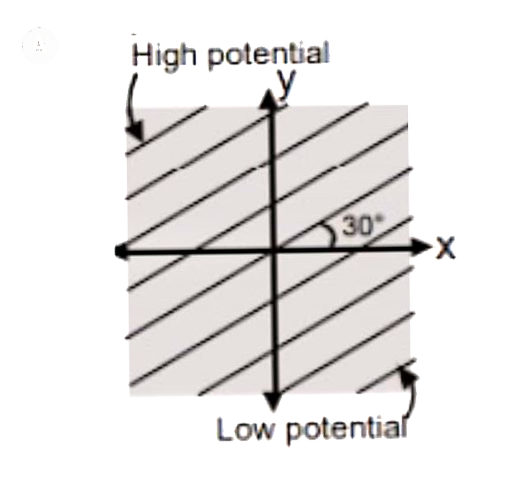
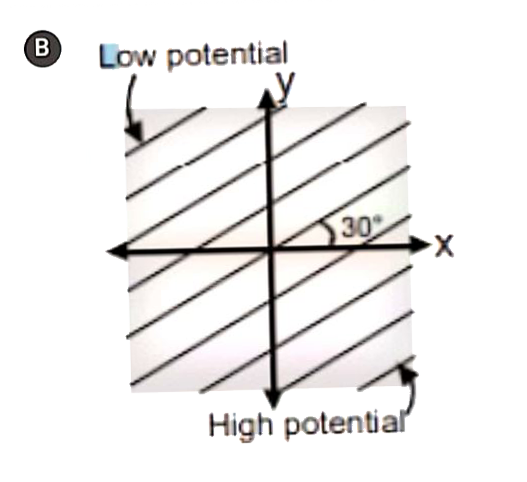
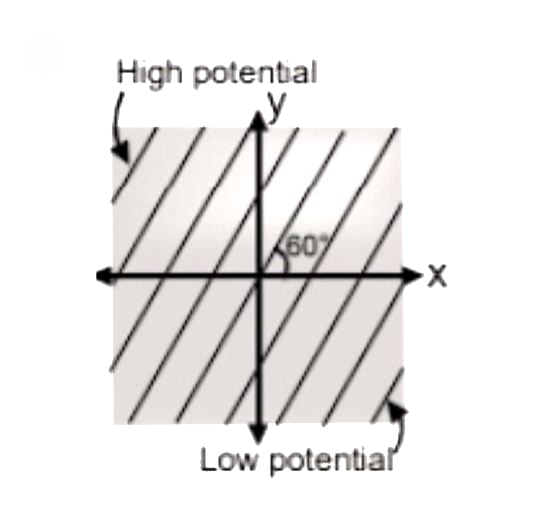
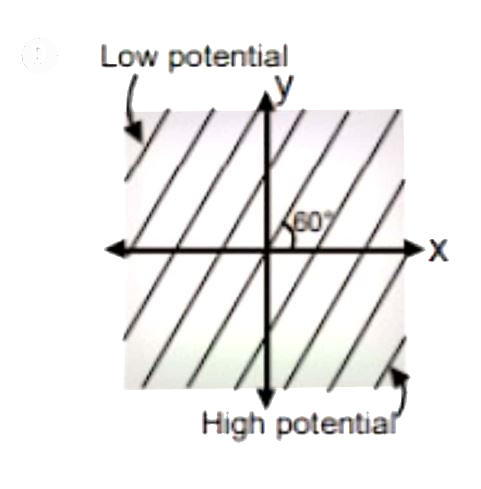
The electric field intensity at all points in space is given by `vecE = sqrt(3)hati - hatj` `V//m`. The nature of equipotential lines is x-y plane is given by

A

B

C

D

Text Solution

AI Generated Solution

The correct Answer is:

To solve the problem, we need to analyze the given electric field vector and determine the nature of the equipotential lines in the x-y plane. ### Step-by-Step Solution: 1. **Identify the Electric Field Vector**: The electric field intensity is given as: \[ \vec{E} = \sqrt{3} \hat{i} - \hat{j} \quad \text{(V/m)} \] Here, we can identify the components of the electric field: - \( E_x = \sqrt{3} \) - \( E_y = -1 \) 2. **Calculate the Angle of the Electric Field**: The angle \( \theta \) that the electric field makes with the x-axis can be calculated using the tangent function: \[ \theta = \tan^{-1}\left(\frac{E_y}{E_x}\right) = \tan^{-1}\left(\frac{-1}{\sqrt{3}}\right) \] Evaluating this gives: \[ \theta = -30^\circ \] 3. **Determine the Angle of the Equipotential Lines**: Equipotential lines are always perpendicular to the electric field lines. Therefore, the angle \( \phi \) that the equipotential lines make with the x-axis is given by: \[ \phi = 90^\circ + \theta \] Substituting the value of \( \theta \): \[ \phi = 90^\circ - 30^\circ = 60^\circ \] 4. **Direction of Potential Change**: The electric field points in the direction of decreasing potential. Since \( E_x \) is positive and \( E_y \) is negative, the potential decreases in the positive x-direction and negative y-direction. This indicates that the equipotential lines will be oriented such that they decrease in potential towards the fourth quadrant. 5. **Conclusion**: The equipotential lines will be straight lines making an angle of \( 60^\circ \) with the x-axis, and they will be oriented such that the potential decreases towards the fourth quadrant. ### Final Answer: The nature of the equipotential lines in the x-y plane is that they are straight lines making an angle of \( 60^\circ \) with the x-axis, decreasing in potential towards the fourth quadrant. ---
Promotional Banner

Similar Questions

Explore conceptually related problems

The electric field intensity at all points in space is given by vec(E) = sqrt(3) hat (i) - hat (j) volts/metre. A square frame LMNO of side 1 metre is shown in figure. The point N lies in x-y plane. The initial angle between line ON and x-axis is theta = 60^(@) The work done by electric field in taking a point charge of 1 muC from origin O to point M is -

The electric field intensity at all points in space is given by vec(E) = sqrt(3) hat (i) - hat (j) volts/metre. A square frame LMNO of side 1 metre is shown in figure. The point N lies in x-y plane. The initial angle between line ON and x-axis is theta = 60^(@) The magnitude of electric flux through area enclosed in square frame LMNO is -

the electric field intensity at all points is space is given by vecE=sqrt3hati-hatj volts/meter. A square frame LMNO of side 1 meter is shown in the figure. The point N lies in x-y plane. The initial angle between line ON and x -axis is theta = 60^(@) The work done by electric field in taking a point charge 1muC from origin O to point M is

the electric field intensity at all points is space is given by vecE=sqrt3hati-hatj volts/meter. A square frame LMNO of side 1 meter is shown in the figure. The point N lies in x-y plane. The initial angle between line ON and x -axis is theta = 60^(@) the magnitude of electric flux through area enclosed in square frame LMNO is

The electrostatic potential V at any point (x, y, z) in space is given by V=4x^(2)

The gravitational field in a region is given by vecE=(yhati+ xhatj) N/kg, where x and y are in metres. The equipotential lines are plotted as

The electric field in a region of space is given by E=5hati+2hatjN//C . The flux of E due ot this field through an area 1m^2 lying in the y-z plane, in SI units is

The electric field in a region is given by vecE = (A/x^3) hati. Write a suitable SI unit for A. Write an expression for the potential in the region assuming the potential at infinity to be zero.

The electric field in a certain region is given by E=(5hati-3hatj)kV//m . Find the difference in potential V_B-V_A . If A is at the origin and point B is at a. (0,0,5)m, b. (4,0,3) m.

Electrostatic field in a region is given by , vecE= (yzhati + zxhatj + xyhatk)V/m , where x,y and z are in m. If electric potential at origin is zero, then potential at (1m,1m, 1m) is
