Home
Class 12
PHYSICS
A thin bi-convex lens made out of a mate...

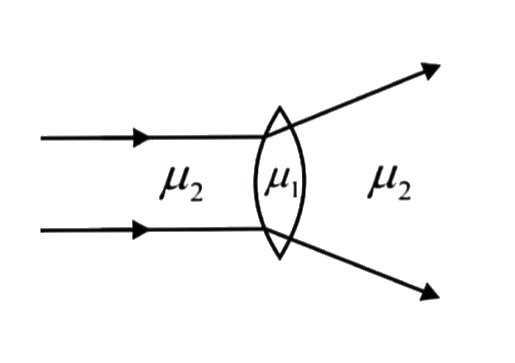
A thin bi-convex lens made out of a material of refractive index `mu_(1)` is place in a medium of refractive index `mu_(2)`. A paraxial beam of light, parallel to the principal axis of the lens, is shown in the figure. Based on the ray diagram, we can conclude that

A

`mu_(1) gt mu_(2)`

B

`mu_(1)ltmu_(2)`

C

`mu_(1)=mu_(2)`

D

`mu_(1) lt mu_(2)`

Text Solution

Verified by Experts

The correct Answer is:

D
Promotional Banner

Similar Questions

Explore conceptually related problems

A lens made of material of Refractive index mu_(2) is surrounded by a medium of Refractive Index mu_(1) . The focal length f is related as

A lens made of material of Refractive index mu_(2) is surrounded by a medium of Refractive Index mu_(1) . The focal length f is related as

If a convex lens of refractive index mu _l is placed in a medium of refractive index mu_m Such that mu_l > mu_m > mu_(air) then

A double convex lens of refractive index m_(1) is immersed in a liquid of refractive index m_(2) . This lens will act as:

When a lens of power P (in air) made of material of refractive index mu is immersed in liquid of refractive index mu_(0) Then the power of lens is:

A sphere of radius R made of material of refractive index mu_(2) is placed in a medium of refractive index mu_(1) . Where would an object be placed so that a real image is formed at equidistant fromk the sphere? ltbgt

A transparent cube of side d, made of a material of refractive index mu_(2) , is immersed in a liquid of refractive index mu_(1)(mu_(1)ltmu_(2)) . . A ray is incident on the face AV at an angle theta (shown in the figure). Total internal refraction takes place at point E on the face BC. Then must satisfy:

A transparent cube of side d, made of a material of refractive index mu_(2) , is immersed in a liquid of refractive index mu_(1)(mu_(1)ltmu_(2)) . . A ray is incident on the face AV at an angle theta (shown in the figure). Total internal refraction takes place at point E on the face BC. Then must satisfy:

A biconcave lens made of a transparent material of refractive index 1.25 is immersed in water of refractive index 1.33. Will the lens behave as a converging or a diverging lens? Give reason.

A double convex lens, lens made of a material of refractive index mu_(1) , is placed inside two liquids or refractive indices mu_(2) and mu_(3) , as shown. mu_(2)gtmu_(1)gtmu_(3) . A wide, parallel beam of light is incident on the lens from the left. The lens will give rise to
