Home
Class 12
PHYSICS
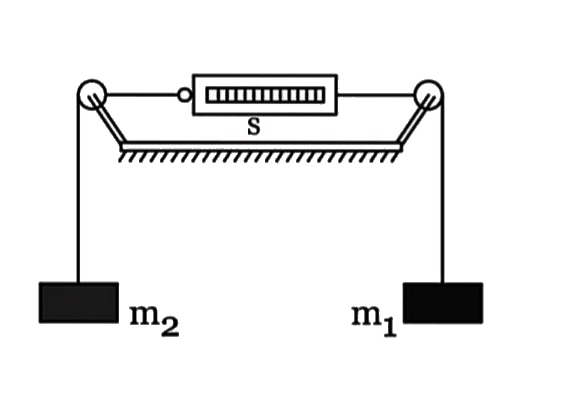
In the arrangement shown, the pulleys, s...

In the arrangement shown, the pulleys, string and the spring balance, all the ideal. If `m_(1) gt m_(2)`, then the reading of the spring balance is

A

(a)`m_(1) - m_(2)`

B

(b)`(1)/(2) (m_(1)+m_(2))`

C

(c)`(4m_(1)m_(2))/(m_(1)+m_(2))`

D

(d)`(2m_(1)m_(2))/(m_(1)+m_(2))`

Text Solution

Verified by Experts

Promotional Banner

Similar Questions

Explore conceptually related problems

The reading in the spring balance is

The reading in the spring balance is:

For the arrangement shown in the figure, the reading of spring balance is

In the arrangement shown in figure, pulleys are light and spring are ideal. K_(1) , k_(2) , k_(3) and k_(4) are force constant of the spring. Calculate period of small vertical oscillations of block of mass m .

A cubical block (side l ) is in equilibrium at the interface of two liquids A and B. The spring balance reads W Newton. If the block is weighted in air, the reading of the spring balance will be :

What is the reading of the spring balance in the following device?

An arrangement of pulleys and blocks is shown in the figure . The two pulleys and the strings are ideal. If m_(2) gt m_(1) , then which of the following (s) is / are wrong ?

In the arrangement shown in the diagram, pulleys are small and springs are ideal. k_(1)=k_(2)=k_(3)=k_(4)=10Nm^(-1) are force constants of the springs and mass m=10kg. If the time period of small vertical oscillations of the block of mass m is given by 2pix seconds, then find the value of x.

An air tight cage with are parrot sitting in it is suspended from the spring balance. The parrot starts flying. The reading of the spring balance will

Figure shows a 5 kg ladder hanging from a string that is connected with a ceiling and is having a spring balance connected in between. A boy of mass 25 kg is climbing up the ladder at acceleration 1(m)/(s^2) . Assuming the spring balance and the string to be massless and the spring to show a constant reading, the reading of thespring balance is: (Take g=10(m)/(s^2) )

