Home
Class 12
PHYSICS
A blcok A starts sliding on a smooth tra...

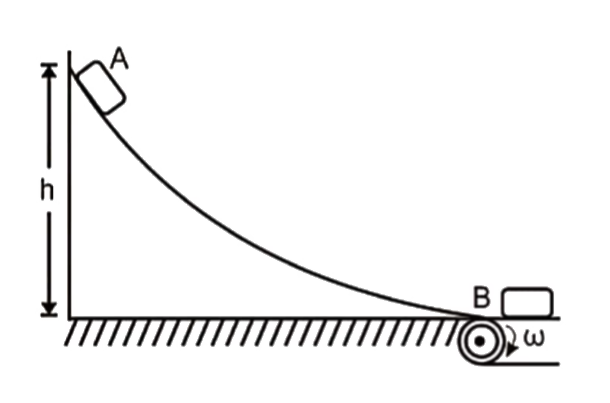
A blcok A starts sliding on a smooth track from a height h as shown in the figure. The track smoothly joins into a conveyor belt which is being driven by a pulley of radius r. I the angular velocity `omega` of the pulley is such that the block A doesn't slip on the belt, the value of `omega` is

A

`(sqrt(gh))/(r)`

B

`(sqrt(hg))/(2r)`

C

`(sqrt(2gh))/(r)`

D

`(2sqrt(gh))/(r)`

Text Solution

Verified by Experts

Promotional Banner

Similar Questions

Explore conceptually related problems

A small block of mass m slides along a smooth frictional track as shown in the figure. If it starts from rest at P, what is the resultant force acting on it at Q?

The pulley shown in figure has a moment of inertia I about it's axis and its radius is R. Find the magnitude of the acceleration of the two blocks. Assume that the string is light and does not slip on the pulley.

Particles are released from rest A and slide down the smooth surface of hight h to a conveyor B. The correct angular veleocity omega of the coneyor pulley of radius r to prevent any sliding on the belt as the particles transfer to the conveyor is

A block of mass m starts from rest and slides down a frictionless semi-circular track from a height h as shown. When it reaches the lowest point of the track, it collides with a stationary piece of putty also having mass m. If the block and the putty . stick together and continue to slide, the maximum height that the block-putty system could reach is

A block of mass m is placed at the top of a smooth wedge ABC. The wedge is rotated about an axis passing through C as shown in the figure - 3.81. The minimum value of angular speed omega such that the block does not slip on the wedge is :

A section of fixed smooth circular track of radius R in vertical plane is shown in the figure. A block id released from position A and leaves the treack at B The radius of curvanture of its trajectory just after it leaves the track B is ?

An object of mass m is released from rest at a height h above the surface of a table. The object slides along the inside of the loop. The loop track consisting of a ramp and a circular loop of radius R shown in the figure. Assume that the track is frictionless. When the object is at the top of the circular track it pushes against the track with a force equal to three times its weight. What height was the object dropped from?

A ring of mass m = 0.3kg can slide freely on smooth vertical rod. A light and inextensible string is connected to the ring and passes over a smooth and fixed pulley as shown in the figure. The distance of the pulley from the rod is 0.8m and the other end of the string is connected to a block of mass M = 0.5kg. The ring is held in level with pulley and then released from rest. The distance by which the ring moves down before coming to rest for the first time is 0.75K. Find K.

A uniform solid cone of mass m, base radius ‘R’ and height 2R, has a smooth groove along its slant height as shown in figure. The cone is rotating with angular speed omega , about the axis of symmetry. If a particle of mass ‘m’ is released from apex of cone, to slide along the groove, then angular speed of cone when particle reaches to the base of cone is

An inclined plane of angule a is fixed onto a horizontal turntable with its line of greater slope in same plane as a diameter of forntable .A small block is placed on the inclined plane a distance r from the axis the coefficient of fraction between the block and the inclined plane is mu The turntable along with incline plane spins about its axis with constant minimum angular velocity omega a. Find an capression for the minimum angular velocity omega to prevent the block from sliding down the plane in term of g, r, mu and the plane omega b. Now a block of mass but having coefficient friction (with inclined plane) 2mu is kept instead of the original block . find the radius of friction force acting between block and incline now to the friction force active in part (a)

