Home
Class 12
PHYSICS
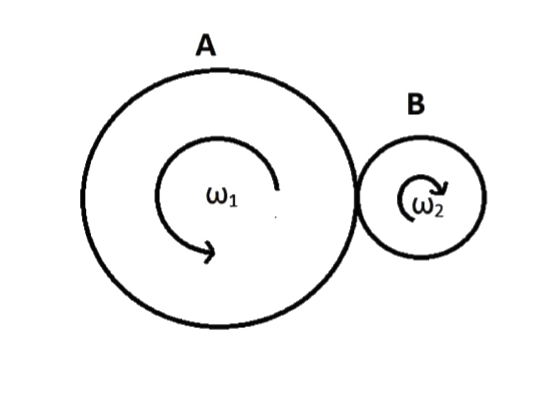
Two discs A and B are in contact and rot...

Two discs A and B are in contact and rotating with angular velocity with angular velocities `omega_(1) and omega_(2)` respectively as shown. If there is no slipping between the discs, then

A

(a)`omega_(1)=omega_(2)`

B

(b)`omega_(1) gt omega_(2)`

C

(c)`omega_(1) lt omega_(2)`

D

(d)data insufficient

Text Solution

Verified by Experts

Promotional Banner

Similar Questions

Explore conceptually related problems

Two uniform circular rough disc of moment of inertia I_(1) and (I_(1))/(2) are rotating with angular velocity omega_(1) and (omega_(1))/(2) respectively in same direction. Now one disc is placed the other disc co-axially. The change in kinetic energy of the system is :

A rod is rotating with angular velocity omega about axis AB. Find costheta .

The graph between the angular momentum J and angular velocity omega will be :-

Two discs of same moment of inertia rotating their regular axis passing through centre and perpendicular to the plane of disc with angular velocities omega_(1) and omega_(2) . They are brought into contact face to the face coinciding the axis of rotation. The expression for loss of energy during this process is :

Two discs of same moment of inertia rotating their regular axis passing through centre and perpendicular to the plane of disc with angular velocities omega_(1) and omega_(2) . They are brought into contact face to the face coinciding the axis of rotation. The expression for loss of enregy during this process is :

Two discs of moments of inertia I_1 and I_2 about their respective axes , rotating with angular frequencies omega_1 and omega_2 respectively, are brought into contact face to face with their axes of rotation coincident. The angular frequency of the composite disc will be

If two disc of moment of inertia l_(1) and l_(2) rotating about collinear axis passing through their centres of mass and perpendicular to their plane with angular speeds omega_(1) and omega_(2) respectively in opposite directions are made to rotate combinedly along same axis, then the magnitude of angular velocity of the system is

A disc of mass m has a charge Q distributed on its surface. It is rotating about an XX' with a angular velocity omega . The force acting on the disc is

Two discs of moments of inertia I_(1) and I_(2) about their respective axes (normal to the disc and passing through the centre), and rotating with angular speed omega_(1) and omega_(2) are brought into contact face to face with their axes of rotation coincident . What is the angular speed of the two-disc system ?

When a disc rotates with uniform angular velocity, which of the following is not true ?

