Home
Class 12
PHYSICS
If the density of a planet is constant, ...

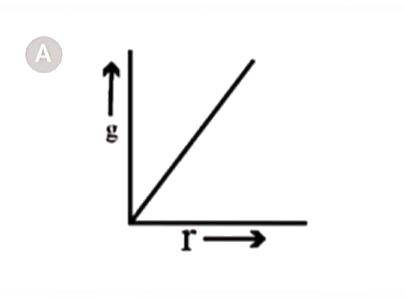
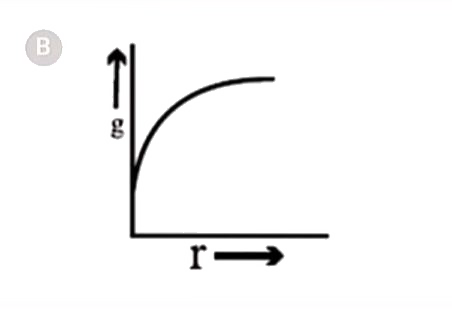
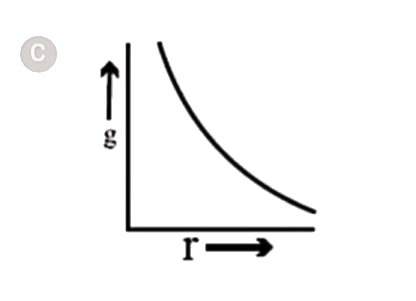
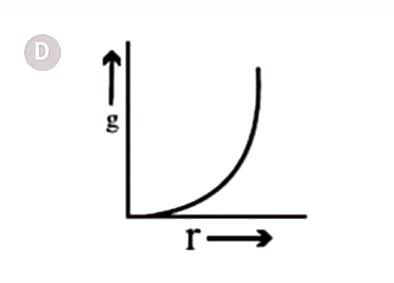
If the density of a planet is constant, then the curve between value of g on its surface and its radius r will be-

A

B

C

D

Text Solution

AI Generated Solution

The correct Answer is:

To solve the problem, we need to establish the relationship between the gravitational acceleration \( g \) at the surface of a planet and its radius \( r \), given that the density of the planet is constant. ### Step-by-Step Solution: 1. **Understanding the relationship**: The gravitational acceleration \( g \) at the surface of a planet is given by the formula: \[ g = \frac{G \cdot M}{R^2} \] where \( G \) is the gravitational constant, \( M \) is the mass of the planet, and \( R \) is the radius of the planet. 2. **Expressing mass in terms of density**: Since the density \( \rho \) of the planet is constant, we can express the mass \( M \) in terms of density and volume: \[ M = \rho \cdot V \] The volume \( V \) of a sphere is given by: \[ V = \frac{4}{3} \pi R^3 \] Therefore, we can write: \[ M = \rho \cdot \frac{4}{3} \pi R^3 \] 3. **Substituting mass back into the equation for \( g \)**: Now, substituting the expression for \( M \) into the equation for \( g \): \[ g = \frac{G \cdot \left(\rho \cdot \frac{4}{3} \pi R^3\right)}{R^2} \] 4. **Simplifying the equation**: This simplifies to: \[ g = \frac{G \cdot \rho \cdot \frac{4}{3} \pi R^3}{R^2} = \frac{4}{3} \pi G \rho R \] Here, we can see that \( g \) is directly proportional to \( R \): \[ g \propto R \] 5. **Interpreting the relationship**: Since \( g \) is directly proportional to \( R \), if we plot \( g \) against \( R \), we will get a straight line that passes through the origin. ### Conclusion: Thus, the curve between the value of \( g \) on the surface of the planet and its radius \( r \) will be a straight line passing through the origin. ### Final Answer: The answer is option A: A straight line passing through the origin. ---
Promotional Banner

Similar Questions

Explore conceptually related problems

If the earth stops rotating, the apparent value of g on its surface will

The two metallic plates of radius r are placed at a distance d apart and its capacity is C . If a plate of radius r//2 and thickness d of dielectric constant 6 is placed between the plates of the condenser, then its capacity will be

A planet has twice the density of earth but the acceleration due to gravity on its surface is exactly the same as that on the surface of earth. Its radius in terms of earth's radius R will be

The density of a newly discovered planet is twice that of earth. The acceleration due to gravity at the surface of the planet is equal to that at the surface of the earth. If the radius of the earth is R , the radius of the planet would be

A spherical charged conductor has surface charge density σ.The intensity of electric field and potential on its surface are E and V, now radius is halved keeping surface charge density to be constant. Then the new values will be

A hypothetical planet in the shape of a sphere is completely made of an incompressible fluid and has a mass M and radius R. If the pressure at the surface of the planet is zero, then the pressure at the centre of the planet is [G = universal constant of gravitation]

A planet has a mass of eight time the mass of earth and denisity is also equal to eight times a the average density of the earth. If g be the acceleration due to earth's gravity on its surface, then acceleration due to gravity on planet's surface will be

If radius of earth is R , then the height h at which the value of g becomes (1/49)th of its value at the surface is

Assertion : If the radius of earth is decreased keeping its mass constant, effective value of g may increase or decrease at pole. Reason : Value of g on the surface of earth is given by g= (Gm)/(R^(2)) .

The acceleration due to gravity on the surface of a planet is one - fourth of the value on Earth. When a brass ball is brought to this planet , its
