Home
Class 12
PHYSICS
Find the electric flux (in S.I. unit) th...

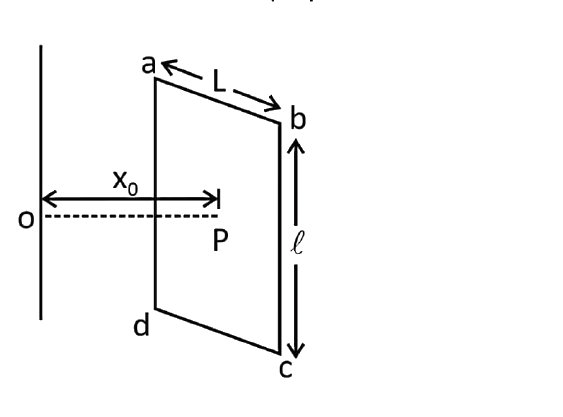
Find the electric flux (in S.I. unit) through the rectangular plate abcd of length `l = 2m` width L and whose centre is at a distance `OP = x_(0) = L/2` from an infinite line of charge with linear charge density `lambda = 1/(36 pi) xx 10^(-9) Cm^(-1)`. Consider that the plate of the frame is perpendicular to line OP.

Text Solution

Verified by Experts

The correct Answer is:

0.5
Promotional Banner

Similar Questions

Explore conceptually related problems

Find the electric flux crossing the wire frame ABCD of length l, width b, and center at a distance OP = d from an infinite line of charge with linear charge density lambda . Consider that the plane of the frame is perpendicular to the line OP

Intensity of electric field at a perpendicular distance of 0.5 m from an infinitely long line charge having linear charge density (lamda) is 3.6 xx 10^(3) Vm^(-1) . Find the value of lamda

Find electric field at point A, B, C, D due to infinitely long uniformly charged wire with linear charge density lambda and kept along z-axis (as shown in figure). Assume that all the parameters are in S.l. units.

An infinite line charge produces a field of 9xx10^(4) N/C at a distance of 2cm. Calculate the linear charge density.

An infinite line charge produces a field of 7.182 xx 10^(8) N//C at distance of 2 cm. the linear charge density is

An infinite line charge produces a field of 18xx10^(4) N/C at a distance of 2 metre from it. The linear charge density is

An infinite line charge produces a field of 9xx10^(-4)NC^(-1) at a distance of 2 cm. Calculate the linear charge density.

An infinite line charge Produces a field of 9 x 10^(4)NC^(-1) at a distance of 3 cm. Calculate the linear charge density.

Find the magnitude of the electric field at a point 4 cm away from a line charge of density 2 xx 10^(-6) C m^(-1) .

An electric dipole consists of charges +- 2.0 xx 10^(-8) C separated by distance of +- 2.0 xx 10^(-3) m. It is placed at a distance of 6 cm from a line charge of linear charge density 4.0 xx 10^(-4) Cm^(-1) as shown in figure such that the dipole makes an angle of theta = 60^@ with line AB. Find the force acting on the dipole.
