Home
Class 12
PHYSICS
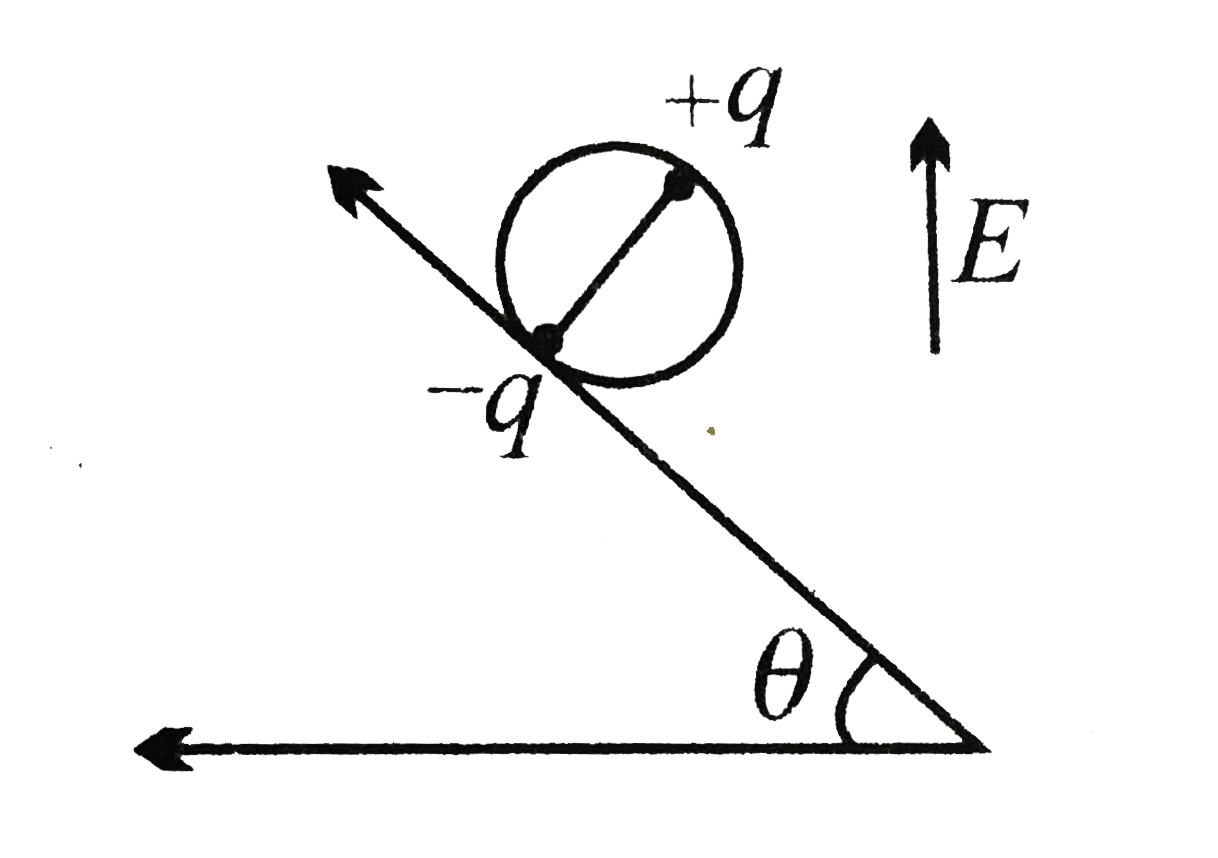
A wheel having mass mu has charges +q an...

A wheel having mass `mu` has charges `+q and -q` on diametrically opposite points. It remains in equilibrium on a rough inclined plane in the presence of uniform vertical electric field E =

A

`(mg)/(q)`

B

`(mg)/(2q)`

C

`(mg tan theta)/(2q)`

D

none

Text Solution

Verified by Experts

The correct Answer is:

B
Promotional Banner

Similar Questions

Explore conceptually related problems

A wheel having mass m has charges +q and -q on diametrically opposite points . It remains in equilibrium on a rough inclined plane in the presence of uniform vertical electric field vec E= .

Two point charge +q and -q are fixed on diameterically opposite point on the unirom ring, such that -q is at bottom and is contact will a perfect insulator incline plane. Total mass is equal to m remains in equilibrium on the rough inclined plane in the presence of uniform vertical electric field. Then

Find the emf across points P and Q which are diametrically opposite points of a semicircular closed loop moving in a magnetic field as shown in .

find out mass of the charge Q, so that it remains in equilibrium for the given configuration.

Find the minimum force required to keep a block of mass m in equilibrium on a rough inclined plane with inclination alpha and coefficient of friction mu( lt tan alpha) .

Find the emf across points P and Q which are diametrically opposite points a semicircular closed loop moving in a magnetic field as shown in . Also draw the electrical equivalence od each branch.

Find the emf across points P and Q which are diametrically opposite points a semicircular closed loop moving in a magnetic field as shown in . Also draw the electrical equivalence od each branch.

A uniformly charged ring having total charge Q and of radius R is fixed in such a way so that plane of the ring is horizontal. A charged particle of charge q and mass m is in equilibrium at any point lying on y -axis under the combined forces of electric field and earth's gravitational field. Choose the correct statements

An electric current I enters and leaves a uniform circular wire of radius a through diametrically opposite points. A charged paricle q moving along the axis of the circular wire passes through its centre at speed v. The magnetic force acting on the particle when it passes through the centre has a magnitude

An electric current I enters and leaves a uniform circular wire of radius a through diametrically opposite points. A charged paricle q moving along the axis of the circular wire passes through its centre at speed v. The magnetic force acting on the particle when it passes through the centre has a magnitude
