Home
Class 12
PHYSICS
A disc of radius 0.1 mrolls without slid...

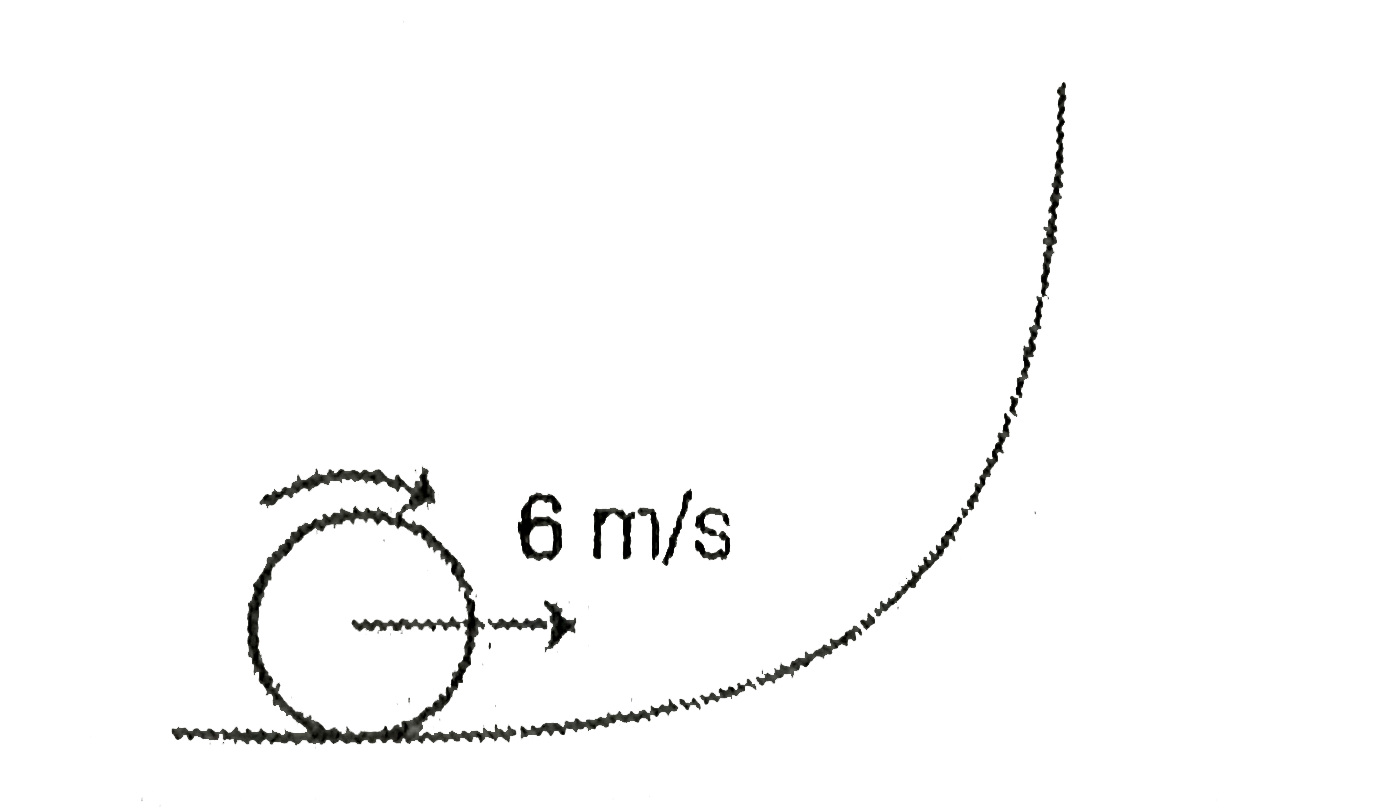
A disc of radius 0.1 mrolls without sliding on a horizontal suirface with a velocity of 6 m`//`s. It then ascends a smooth continous track as shown in figure. The height upto which it will ascend is (g=`10 m//s^(2)`)

A

2.4m

B

0.9m

C

2.7 m

D

1.8 m

Text Solution

Verified by Experts

The correct Answer is:

D
Promotional Banner

Similar Questions

Explore conceptually related problems

A wheel ( to be considered as a ring ) of mass m and radius R rolls without sliding on a horizontal surface with constant velocity v. It encounters a step of height R/2 at which it ascends without sliding

A disc of mass M and radius R rolls on a horizontal surface and then rolls up an inclined plane as shown in the figure. If the velocity of the disc is v, the height to which the disc will rise will be:

A disc of mass 4.8 kg and radius 1 m is rolling on a horizontal surface without sliding with angular velocity of 600 rotations/min. What is the total kinetic energy of the disc ?

A particle is thrown with a velocity of u m/s. it passes A and B as shown in figure at time t_(1) = 1 " s " and t_(2) = 3 s . The value of u is (g = 10 m/ s^(2) )

A cylinder of 10 kg is sliding in a plane with an initial velocity of 10 m / s . If the coefficient of friction between the surface and cylinder is 0.5 then before stopping, it will cover. (g=10m//s^(2))

If a solid sphere of mass 1 kg and radius 0.1 m rolls without slipping at a uniform velocity of 1 m/s along a straight line on a horizontal floor, the kinetic energy is

A disc of mass m and radius R is rolling without slipping as shown in the figure. The magnitude of net velocity of the point P is (OP = R/2)

A block of 10 g slides on smooth horizontal surface with 20 m/s towards a spring of spring constant 100 N/m placed horizontally (as shown in figure). The maximum compression in spring is

A circular disc of mass 2 kg and radius 10 cm rolls without slipping with a speed 2 m/s. The total kinetic energy of disc is

A body falling a vertically up with initial velocity 52 m/s from the ground passes twice a point at h height above at an interval of 10 s. The height h is (g=10m//s^(2))
