Home
Class 12
PHYSICS
A conductor rod AB moves parallel to X-a...

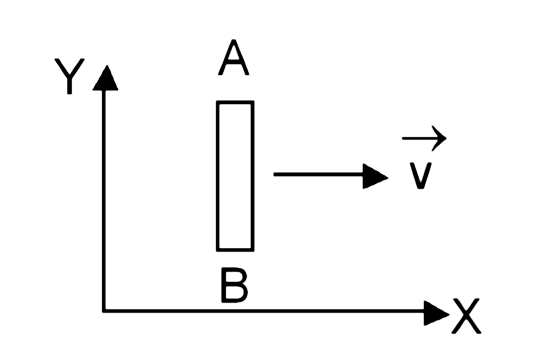
A conductor rod AB moves parallel to X-axis in a uniform magnetic field, pointing in the positive Z-direction. The end A of the rod gets-

A

positively charged

B

negatively charged

C

neutral

D

first positively charged and then negatively charged

Text Solution

Verified by Experts

The correct Answer is:

A
Promotional Banner

Similar Questions

Explore conceptually related problems

A conducting rod AB moves parallel to the x-axis (see Fig.) in a uniform magnetic field pointing in the positive z-direction. The end A of the rod gets positively charged. .

A square loop of side 10 cm with its side parallel to X, and y axis is kept in a uniform magnetic field pointing towards positive z-direction. If magnetic field changes at the rate of 0.1 T/s, then induced emf is

A rod AB moves with a uniform velocity v in a uniform magnetic field as shown in figure

An infinte wire place along z-axis has current I_(1) in positive z-direction A conducting rod placed in xy plane parallel to y-axis has current I_(2) in positive y-direction The ends of the rod subtend +30^(@) and -60^(@) at the origin with positive x direction The rod is at a distance a from the origin. Find net force on the rod .

A small conducting rod of length l, moves with a uniform velocity v in a uniform magnetic field B as shown in fig __ A. Then the end X of the rod become positively charged B. The end Y of the rod become positively charged C. The entire rod is unevenly charged D. The rod become hot due to joule heating

An infinitely long cylinder is kept parallel to an uniform magnetic field B directed along positive z-axis. The direction of induced current as seen from the z-axis will be

A proton is moving along the negative direction of X-axis in a magnetic field directed along the positive direction of Y-axis. The proton will be deflected along the negative direction of

An electron having a charged e moves with a velcoity v in postive x direction. A magnetic field acts on it in positive y direction. The force on the electron acts in (where outward direction is taken as positive z-axis)

A conducting rod of length l is hinged at point O. It is a free to rotate in a verical plane. There exists a uniform magnetic field B in horizontal direction. The rod is released from the position shown. The potential difference between the two ends of the rod is proportional to
