Home
Class 12
PHYSICS
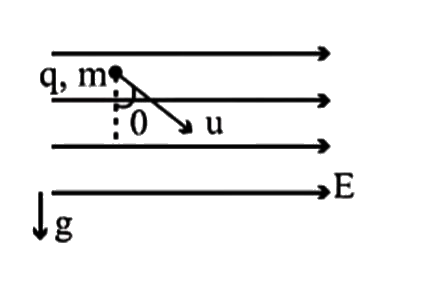
A particle of mass m and charge q is thr...

A particle of mass m and charge q is thrown from a point in space where uniform gravitational field & electric field are present.The particle

(1) may follow a straight line
( 2) may follow a circular path
( 3) may follow a parabolic apth

A

1 & 2 are correct

B

1 & 3 are correct

C

2& 3 are correct

D

all these are correct

Text Solution

Verified by Experts

The correct Answer is:

B
Promotional Banner

Similar Questions

Explore conceptually related problems

A particle of mass m and charge q is thrown in a region where uniform gravitational field and electric field are present. The path of particle:

A particle of mass .m. and charge q is placed at rest in a uniform electric field E and then released. The K.E. attained by the particle after moving a distance y is

A charged particle of mass m and charge q is released from rest the position (x_0,0) in a uniform electric field E_0hatj . The angular momentum of the particle about origin.

A particle of mass m and charge q is thrown at a speed u against a uniform electric field E. How much distance will it travel before coming to momentary rest?

A particle of mass m and charge q is placed at rest in a uniform electric field E and then released, the kinetic energy attained by the particle after moving a distance y will be

A particle of mass m and charge Q moving with a velocity v enters a region on uniform field of induction B Then its path in the region is s

A charge particle of mass m and charge q is released from rest in uniform electric field. Its graph between velocity (v) and distance travelled (x) will be :

A charge particle of mass m and charge q is released from rest in uniform electric field. Its graph between velocity (v) and distance travelled (x) will be :

A charged particle of mass m and charge q is released from rest in an electric field of constant magnitude E . The kinetic energy of the particle after time t is

A charged particle of mass m and charge q describes circular motion of radius r in a uniform magnetic field of strength B the frequency of revolution is
