Home
Class 12
CHEMISTRY
Which of the following is incorrect orde...

Which of the following is incorrect order ?

A

`CH_(3)^(-) gt CH_(3)O^(-) gt HO^(-) gt H_(2)O` ( Nucleophilicity in protic solvent )

B

`Cl^(-) gt CH_(3) COO^(-) gt CH_(3) O^(-) gt NH_(2)^(-)` ( Leaving group ability )

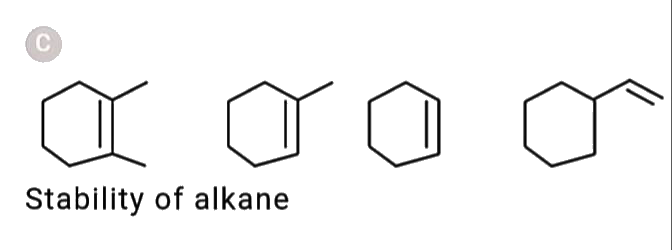
C

D

`CH_(3) - CH_(2) - F gt CH_(3) - CH_(2) - Cl gt CH_(3) - CH_(2) - Br gt CH_(3) - CH_(2) - I` ( Boiling point )

Text Solution

AI Generated Solution

The correct Answer is:

To determine which of the following orders is incorrect, we need to analyze the provided statements step by step. ### Step 1: Analyze Nucleophilicity - **Nucleophilicity** refers to the tendency of a species to donate an electron pair to an electrophile. - Generally, nucleophilicity increases with decreasing stability of the nucleophile. Less stable nucleophiles are more reactive. - Comparing the nucleophiles: 1. **H2O**: Very stable, least nucleophilic. 2. **OH-**: More nucleophilic than H2O due to the negative charge. 3. **OCH3-**: The methyl group (CH3) has a +I effect, which destabilizes the negative charge, making it more nucleophilic than OH-. 4. **CH3-**: Least stable and most nucleophilic due to the lack of electronegativity in carbon. **Correct Order**: CH3- > OCH3- > OH- > H2O ### Step 2: Analyze Leaving Groups - The stability of a leaving group is crucial; more stable leaving groups are better at leaving. - Comparing the leaving groups: 1. **Nitrogen with a negative charge**: Less stable due to lower electronegativity. 2. **Oxygen with a negative charge**: More stable due to higher electronegativity. 3. **O-**: Stabilized by resonance, making it a good leaving group. 4. **Cl-**: Has a vacant d-orbital, allowing it to stabilize the negative charge. **Correct Order**: Cl- > O- > Nitrogen (less stable) ### Step 3: Analyze Alkene Stability - Alkene stability is often determined by hyperconjugation, which depends on the number of alpha hydrogens. - Comparing the alkenes: 1. **Alkene with 10 alpha hydrogens**: Most stable. 2. **Alkene with 7 alpha hydrogens**: Less stable than the first. 3. **Alkene with 4 alpha hydrogens**: Less stable than the second. 4. **Alkene with 1 alpha hydrogen**: Least stable. **Correct Order**: 10 alpha H > 7 alpha H > 4 alpha H > 1 alpha H ### Step 4: Analyze Boiling Points - Boiling point is directly proportional to molar mass. - Comparing the halogens: 1. **Iodine**: Highest molar mass, highest boiling point. 2. **Bromine**: Lower than iodine but higher than chlorine. 3. **Chlorine**: Lower than bromine. 4. **Fluorine**: Lowest molar mass, lowest boiling point. **Correct Order**: I > Br > Cl > F ### Conclusion After analyzing all statements, the incorrect order is related to the boiling points of the halogens. The statement claiming a different order than I > Br > Cl > F is incorrect. ### Final Answer The incorrect order is related to the boiling points of halogens, specifically option D. ---
Promotional Banner

Similar Questions

Explore conceptually related problems

Which of the following is incorrect priority order of functional groups ?

Which of the following order is incorrect ?

Which of the following is an incorrect pair?

Which of the following is an incorrect pair ?

Which of the following is (are) incorrect ?

Which of the following is incorrect statement

Which of the following is incorrect match?

Which of the following is incorrect statement?

Work (W) is the path function. Which of the following order is incorrect?

Which of the following order is incorrect :-
