Home
Class 12
PHYSICS
In the figure, m(A)=2 kg and m(B)=4kg. F...

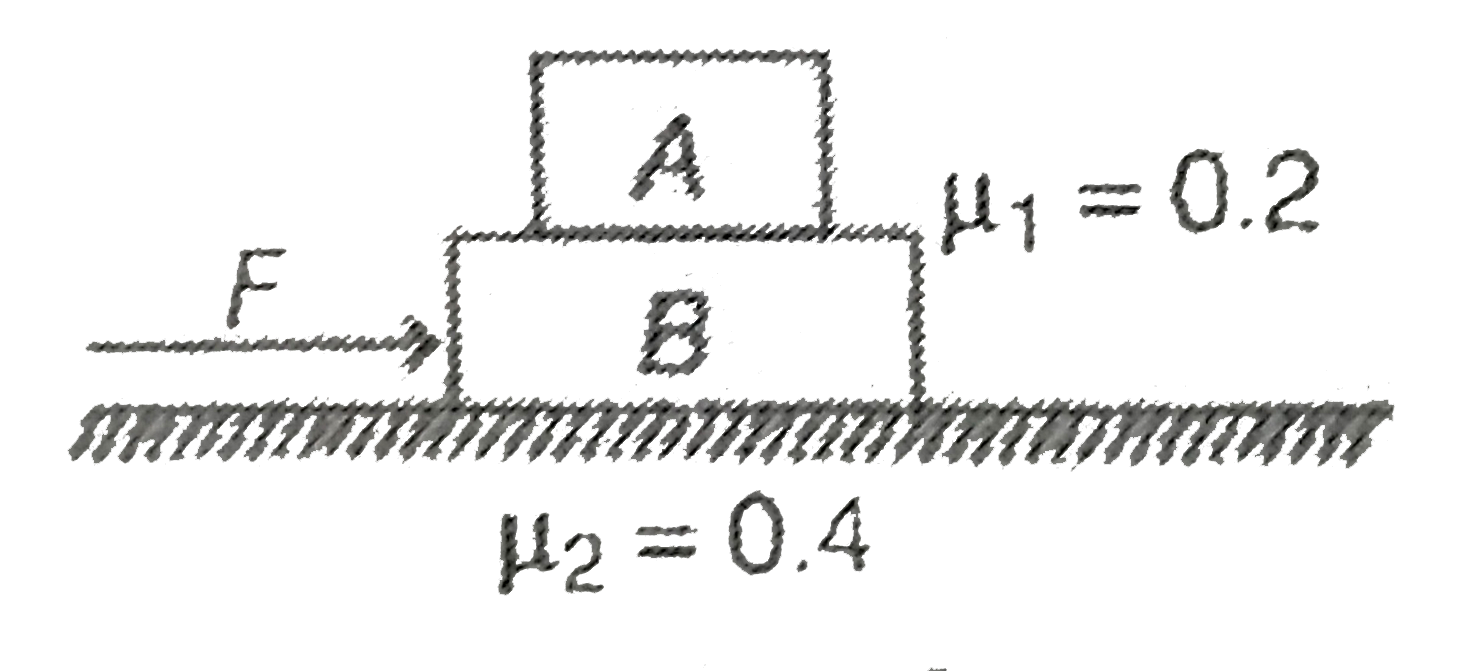
In the figure, `m_(A)=2 kg` and `m_(B)=4kg`. For what minimum value of F,A starts slipping over B? `(g=10m//s^(2))`

A

24 N

B

36 N

C

12 N

D

20 N

Text Solution

Verified by Experts

The correct Answer is:

B
Promotional Banner

Similar Questions

Explore conceptually related problems

A block of mass 10 kg is held at rest against a rough vertical wall [mu=0.5] under the action a force F as shown in figure. The minimum value of F required for it is (g=10m//s^(2))

find minimum value of F such that m_(2) starts its motion on the ground

Two block A and B are arrenged as shown in figure (m_(A) = 5 kg and m_(B) = 10 kg) Find the acceleration of blocks if F = 40 N

Two block of mass m and M are connected means of a metal of a metal wire passing over a frictionless fixed pulley. The area of cross section of the wire is 6.67xx10^(-9)m^(2) and its breaking stress is 2xx10^(9)Nm^(-2) . If m = 1kg. Find the maximum value of M in kg for which the wire will not break. (g=10m//s^(2)) .

In the figure shown, m_(1) = 10kg, m_(2) = 6kg, m_(3) = 4kg. If T_(3) = 40 N, T_(2) = ?

A turn of radius 20 m is banked for the vehicle of mass 200 kg going at a speed of 10 m//s . Find the direction and magnitude of frictional force (a) 5 m//s (b) 15 m//s Assume that friction is sufficient to prevent slipping. (g=10 m//s^(2))

In figure m_(1)= 1 kg and m_(2)= 4 kg Find the mass m of the hanging block which will prevent the smaller block from slipping over the triangular block .All the surface are frictionless and the string and the pulleys are light

Block B of mass 2kg rests on block A of mass 10kg . All surfaces are rought with the value of coefficient of friction as shown in the figure. Find the minimum force F that should be applied on block A to cause relative motion between A and B . (g=10m//s^(2))

The block of mass m_(1) is placed on a wedge of an angle theta , as shown. The block is moving over the inclined surface of the wedge. Friction coefficient between the block and the wedge is mu_(1) , whereas it is mu_(2) between the wedge and the horizontal surface. if mu_(1)=1/2, theta=45^(@), m_(1)=4 kg, m_(2)=5 kg and g=10 m//s^(2) , find minimum value of mu_(2) so that the wedge remains stationary on the surface. express your answer in multiple of 10^(-3)

The block of mass m_(1) is placed on a wedge of an angle theta , as shown. The block is moving over the inclined surface of the wedge. Friction coefficient between the block and the wedge is mu_(1) , whereas it is mu_(2) between the wedge and the horizontal surface. if mu_(1)=1/2, theta=45^(@), m_(1)=4 kg, m_(2)=5 kg and g=10 m//s^(2) , find minimum value of mu_(2) so that the wedge remains stationary on the surface. express your answer in multiple of 10^(-3)
