Home
Class 12
PHYSICS
What would be the period of the free osc...

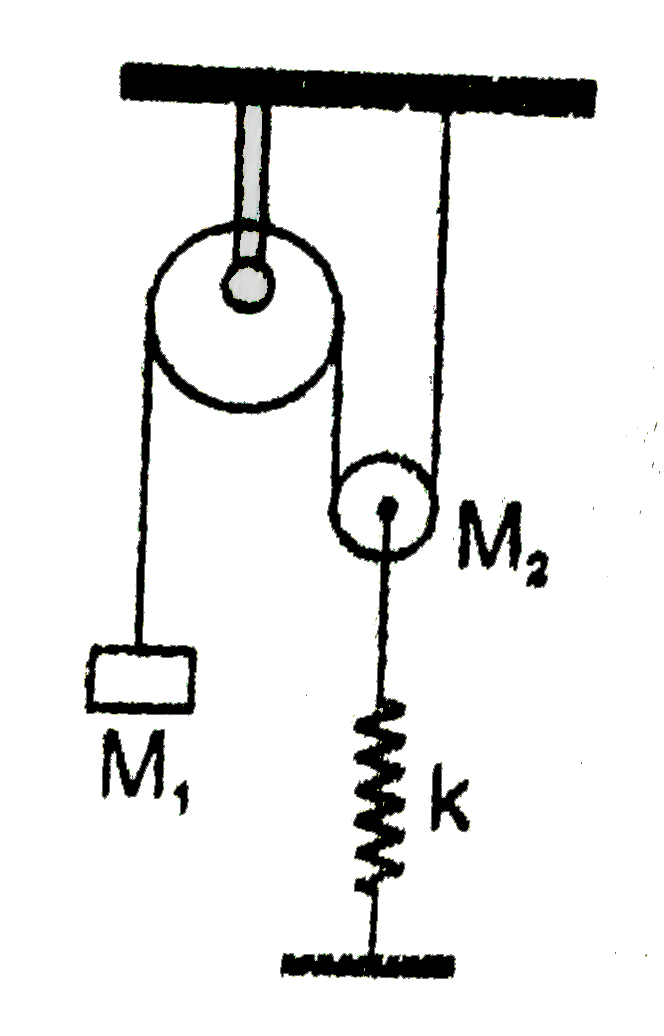
What would be the period of the free oscillations of the system shown here if mass `M_(1)` is pulled down a little force constant of the spring is `k`, mass of fixed pulley is negligible and movable pulley is smooth

A

`2 pi sqrt((4M_(1) + M_(2))/(k))`

B

`2 pi sqrt((4M_(2) + M_(1))/(k))`

C

`4 pi sqrt((4M_(1) + M_(2))/(k))`

D

` pi sqrt((4M_(1) + M_(2))/(k))`

Text Solution

Verified by Experts

The correct Answer is:

A
Promotional Banner

Similar Questions

Explore conceptually related problems

Comparing the L-C oscillations with the oscillations of a spring-block system (force constant of spring=k and mass of block=m), the physical quantity mk is similar to

Find the time period of oscillation of block of mass m. Spring, and pulley are ideal. Spring constant is k.

A mass M is suspended as shown in fig. The system is in equilibrium. Assume pulleys to be massless. K is the force constant of the spring. The extension produced in the spring is given by

A mass M is suspended as shown in fig. The system is in equilibrium. Assume pulleys to be massless. K is the force constant of the spring. If each of the pullies A and B has mass M, then find the net tension force acting on the lower support. Asumme pulleys to be frictionaless.

A mass M is suspended as shown in fig. The system is in equilibrium. Assume pulleys to be massless. K is the force constant of the spring. Find the net tension force acting on the lower support.

In the system shown in the figure, which the following is correct? (Pulleys and strings are of negligible mass)

In the pulley system shown in figure the movable pulleys A,B and C are of mass 1 kg each D and E are fixed pulleys are light and inexensible. Choose the correct alternative (s).

The period of oscillation of mass M suspended from a spring of negligible mass is T. If along with it another mass M is also suspended, the period of oscillation will now be

Two masses as shown are suspended from a massless pulley. Calculate the acceleration of the system when masses are left free.

A pulley fixed to the ceiling carried a thread with bodies of masses m_(1) and m_(2) attached to its ends. The mases of the pulley and the thread are negligible and friction is absent. Find the acceleration of the centre of mass of this system.
