Home
Class 12
PHYSICS
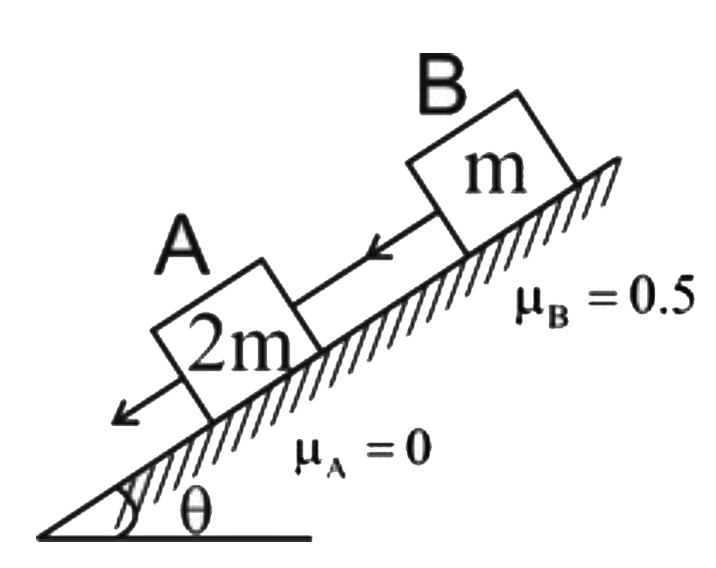
The arrangement is released from rest. T...

The arrangement is released from rest. The minimum angle `theta` at which block A starts sliding downwards is

A

`tan theta = 0`

B

`tan theta = 0.5`

C

`tan theta = 1/6`

D

`tan theta = 1/3`

Text Solution

Verified by Experts

The correct Answer is:

C
Promotional Banner

Similar Questions

Explore conceptually related problems

The minimum force F for which the block starts moving is Find x

In the given system, a block of mass m is resting on a board which makes an angle theta with the horizontal. What should be the minimum value of theta , so that the block just starts moving downwards? The coefficient of friction between the surfaces of the board and the block is mu .

The system is released from rest. All surface are smooth . Find the angle theta at which the acceleration of wedge is maximum. ( given . M/m=1/2 )

The minimum value of acceleration of wedge for which the block start sliding on the wedge, is:

A block of mass m is placed on a rough inclined plane. The corfficient of friction between the block and the plane is mu and the inclination of the plane is theta .Initially theta=0 and the block will remain stationary on the plane. Now the inclination theta is gradually increased . The block presses theinclined plane with a force mgcostheta . So welding strength between the block and inclined is mumgcostheta , and the pulling forces is mgsintheta . As soon as the pulling force is greater than the welding strength, the welding breaks and the blocks starts sliding, the angle theta for which the block start sliding is called angle of repose (lamda) . During the contact, two contact forces are acting between the block and the inclined plane. The pressing reaction (Normal reaction) and the shear reaction (frictional force). The net contact force will be resultant of both. Answer the following questions based on above comprehension: Q. For what value of theta will the block slide on the inclined plane:

A block of mass m is placed on a rough inclined plane. The corfficient of friction between the block and the plane is mu and the inclination of the plane is theta .Initially theta=0 and the block will remain stationary on the plane. Now the inclination theta is gradually increased . The block presses theinclined plane with a force mgcostheta . So welding strength between the block and inclined is mumgcostheta , and the pulling forces is mgsintheta . As soon as the pulling force is greater than the welding strength, the welding breaks and the blocks starts sliding, the angle theta for which the block start sliding is called angle of repose (lamda) . During the contact, two contact forces are acting between the block and the inclined plane. The pressing reaction (Normal reaction) and the shear reaction (frictional force). The net contact force will be resultant of both. Answer the following questions based on above comprehension: Q. If mu=(3)/(4) then what will be frictional force (shear force) acting between the block and inclined plane when theta=30^@ :

A block of mass m is placed on a rough inclined plane. The corfficient of friction between the block and the plane is mu and the inclination of the plane is theta .Initially theta=0 and the block will remain stationary on the plane. Now the inclination theta is gradually increased . The block presses theinclined plane with a force mgcostheta . So welding strength between the block and inclined is mumgcostheta , and the pulling forces is mgsintheta . As soon as the pulling force is greater than the welding strength, the welding breaks and the blocks starts sliding, the angle theta for which the block start sliding is called angle of repose (lamda) . During the contact, two contact forces are acting between the block and the inclined plane. The pressing reaction (Normal reaction) and the shear reaction (frictional force). The net contact force will be resultant of both. Answer the following questions based on above comprehension: Q. If the entire system, were accelerated upward with acceleration a the angle of repose, would:

A triangular prism of mass m placed on it is released from rest on a smooth inclined plane of inclination theta The block does not slip on the prism. Then

When a block is placed on a wedge as shown in figure, the block starts sliding down and the wedge also start sliding on ground. All surfaces are rough. The centre of mass of ( wedge + block ) system will move.

A block of mass 5 kg and surface area 2m^(2) just begins to slide down an inclined plane when the angle on inclination is 30^(@) . Keeping mass same, the surface area of the block is doubled. The angle is which this starts sliding down is
