Home
Class 12
PHYSICS
An iron wire AB has diameter of 0.6 mm a...

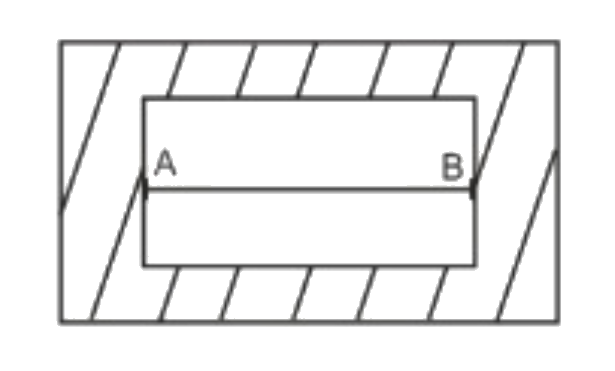
An iron wire AB has diameter of 0.6 mm and length 3 m at `0^(@)C`. The wire is now stretched between the opposite walls of a brass casing at `0^(@)C`. What is the extra tension that will be set up in the wire when the temperature of the system is raised to `40^(@)C`?
Givne `alpha_("brass")=18xx10^(-6)//K`
`alpha_("iron")=12xx10^(-6)//K`
`Y_("iron")=21xx10^(10)N//m_^(2)`

A

14.2 N

B

13.8 N

C

16.3 N

D

21.7 N

Text Solution

Verified by Experts

The correct Answer is:

A
Promotional Banner

Similar Questions

Explore conceptually related problems

An iron wire AB of length 3 m at 0^(@)C is stretched between the oppsote walls of a brass casing at 0^(@)C . The diameter of the wire is 0.6mm . What extra tension will be set up in the wire when the temperature of the system is rasied to 40^(@)C ? Given a_("brass")=18xx10^(-6)//k a_("iron")=12xx10^(-6)//K Y_("iron=21xx10^(10)N//m^(2)

Two fines steel wires , fastened between the projectors of a heavy brass bar, are just taut when the whole system is at 0^(@)C . What is the tensile stress in the steel wires the temperature of the system is raised by 200^(@)C ? ( alpha_("glass") = 2 xx 10^(-5) ^(@)C ^(-1), alpha_("steel") = 1.2 xx 10^(-5)"^(@)C^(-1) , Y_("steel") = 200GNm^(-2) )

A brass scale is graduated at 10^@C . What is the true length of a zinc rod which measures 60.00 cm on this scale at 30^@C ? Coefficient of linear expansion of brass =18xx10^-6K^-1 .

A brass rod and a lead rod each 80 cm long at 0^@C are clamped together at one end with their free ends coinciding. The separatioin of free ends of the rods if the system is placed in a steam bath is ( alpha_("brass")=18xx10^(-6)//^(@)C and alpha_("lead")=28xx10^(-6)//^(@)C )

A brass rod and a lead rod each 80 cm long at 0^@C are clamped together at one end with their free ends coinciding. The separatioin of free ends of the rods if the system is placed in a steam bath is ( alpha_("brass")=18xx10^(-6)//^(@)C and alpha_("lead")=28xx10^(-6)//^(@)C )

A fine steel wire of length 4 m is fixed rigidly in a heavy brass frame as ashown in figure . It is just taut at 20^(@)C . The tensile stress developed in steel wire it whole system is heated to 120^(@)C is :- ( Given alpha _("brass") = 1.8 xx 10^(-5) .^(@)C^(-1), alpha_("steel") = 1.2 xx 10^(-5) .^(@)C , Y_("steel") = 2 xx 10^(11) Nm^(-2), Y_("brass")= 1.7xx10^(7) Nm^(-2) )

A wire 2 mm in diameter is just stretched in between two fixed points at a temperature of 50^(@)C . Calculate the tension in the wire, when the temperature falls to 30^(@)C . Coefficient of linear expansion is 11 xx 10^(-4) l^(@)C and Young modulus is 2.1 xx 10^(11) N m^(2)

A steel rod is 4.00cm in diameter at 30^(@)C A brass ring has an interior diameter of 3.992cm at 30^(@) in order that the ring just slides onto the steel rod the common temperature of the two should be nearly (alpha_(steel) = 11xx10^(-6)(^(@)C) and alpha_(brass)=19xx10^(-6)(^(@)C)

Coefficient of thermal expansion of a wire varies with temperature T as alpha = 1.6 xx 10^(-6) T , where T is temperature in degree Celsius. If the length of wire is 10 m at 0^@C , what is the change in length of wire (in mm), when its temperature is raised to 25^@C ?

A second's clock with a iron pendulum is constructed so a to keep correct time at 10^(@)C . Give alpha_("iron")=12xx10^(-6) per ""^(@)C . What will be the change in the rate when the temperature rises to 25^(@)C ?
