Home
Class 12
PHYSICS
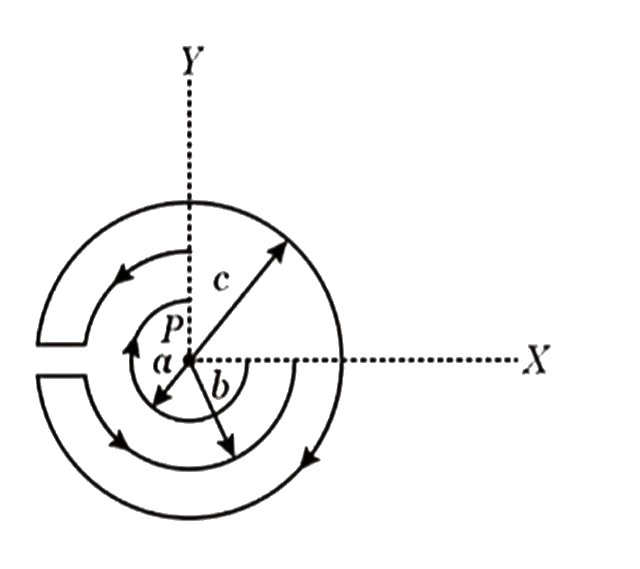
For c=2a and c lt b lt c, the magnetic f...

For `c=2a and c lt b lt c`, the magnetic field at the point P will be zero when-

A

a=b

B

`a=3/5` b

C

`a=(5)/(3)b`

D

`a=(1)/(3)b`

Text Solution

Verified by Experts

The correct Answer is:

C
Promotional Banner

Similar Questions

Explore conceptually related problems

For c=2a if, the magnetic field at point P will be zero when

A magnetic field B=B_(0)hatj exists in the region a lt x lt 2a and B=-B_(0)hatj , in the region 2a lt x lt 3a , where B_(0) is a positive constant. A positive point charge moving with as velocity v=v_(0)hati , where v_(0) is a positive constant, enters the magnetic field at x=a , the trajectory of the charge in this region can be like:

If a lt b lt c , then find the range of f(x)="|x-a|+|x-b|+|x-c|

Figure shows thick metallic sphere. If it is given a charge +Q , then electric field will be present in the region (A) r lt R_(1) only (B) r gt R_(2) only (C) r lt R_(1) and r gt R_(2) (D) R_(1) lt r lt R_(2)

If a , b, c, d are non-zero integers such that a lt b lt c lt d and mean and median of a, b, c and d are both equal to zero, then which one of the following is correct?

If ax^(2) + bx + c = 0 , a , b, c in R has no real roots, and if c lt 0, the which of the following is ture ? (a) a lt 0 (b) a + b + c gt 0 (c) a +b +c lt 0

If the direction ratios of two lines are lt a, b, c gt and lt b-c, c-a, a-b gt , find the angle between them.

Three concentric metallic spherical shell A,B and C or radii a,b and c (a lt b lt c) have surface charge densities -sigma, + sigma and -sigma . Respectively. The potential of shel A is :

Three concentric spherical metallic spheres A,B and C of radii a , b and c(a lt b lt c) have surface charge densities sigma , -sigma and sigma respectively.

(af(mu) lt 0) is the necessary and sufficient condition for a particular real number mu to lie between the roots of a quadratic equations f(x) =0, where f(x) = ax^(2) + bx + c . Again if f(mu_(1)) f(mu_(2)) lt 0 , then exactly one of the roots will lie between mu_(1) and mu_(2) . If c(a+b+c) lt 0 lt (a+b+c)a , then
