Home
Class 12
PHYSICS
Which of the following curves is correct...

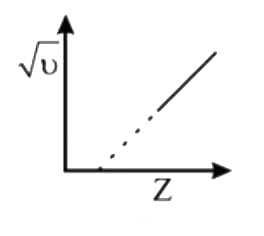
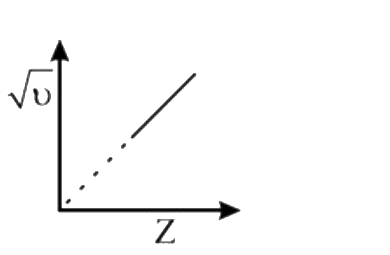
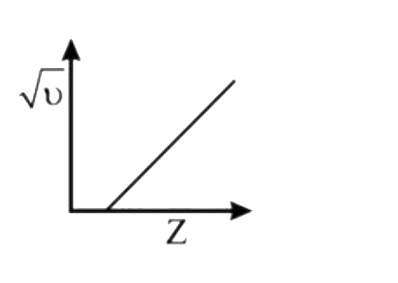
Which of the following curves is correct?

A

B

C

D

None of these

Text Solution

AI Generated Solution

The correct Answer is:

To solve the question regarding which of the given curves is correct based on the relationship between atomic number (z) and frequency (μ), we can follow these steps: ### Step-by-Step Solution: 1. **Understand the Variables**: - The x-axis represents the atomic number (z). - The y-axis represents the square root of frequency (√μ). 2. **Recall Moseley's Law**: - Moseley's Law states that the frequency (μ) of the characteristic X-rays emitted by an element is related to its atomic number (z) by the equation: \[ \sqrt{\mu} = a(z - b) \] - Here, \(a\) and \(b\) are constants. 3. **Analyze the Equation**: - Rearranging the equation gives us: \[ \sqrt{\mu} = az - ab \] - This can be interpreted as a linear equation in the form of \(y = mx + c\), where: - \(y = \sqrt{\mu}\) - \(x = z\) - \(m = a\) (slope) - \(c = -ab\) (y-intercept) 4. **Determine the Y-Intercept**: - The equation indicates that when \(z = b\), \(\sqrt{\mu}\) will be zero. However, since \(z\) cannot be less than \(b\) (as atomic numbers are positive integers), \(\sqrt{\mu}\) will never actually reach zero for any element with a positive atomic number. 5. **Evaluate the Options**: - **Option 1**: A curve that does not pass through the origin and has a positive y-intercept. - **Option 2**: A curve that passes through the origin (which is incorrect since \(\sqrt{\mu}\) cannot be zero). - **Option 3**: A curve that approaches the x-axis but does not touch it. 6. **Conclusion**: - Since \(\sqrt{\mu}\) cannot be zero for any positive atomic number \(z\), the correct curve must not pass through the x-axis. Therefore, the correct option is **Option 1**.
Promotional Banner

Similar Questions

Explore conceptually related problems

Which of the following curve is correct for an ideal gas ?

Which of the following curve is correct for a given amount of an ideal gas at constant pressure?

Acceleration versus time curve for a particle moving in a straight line is shown in the figure. If particle starts from rest at t=0 , then which of the following curve is correct for the same particle.

Which of the following curves correctly represents the process of antibiotic production by Streptomyces sp ?

Shown below are the black body radiation curves at temperature T_(1) and T_(2) (T_(2) gt T_(1)) . Which of the following plots is correct?

Which of the following curves is in accordance with Freundlich adsorption isotherm ?

Which of the following curves corresponds to maximum growth ?

Which of the following curves is in according with Freundlich adsorption isotherm? (a) (b) (c) (d)

For radial probability curves. Which of the following is/are correct ?

A ball is thrown downward with some velocity into a.viscous liquid. Which of the following curves represents correct variation for velocity versus time?
