Home
Class 12
CHEMISTRY
An alkene (A)C(16)H(16) on ozonolysis gi...

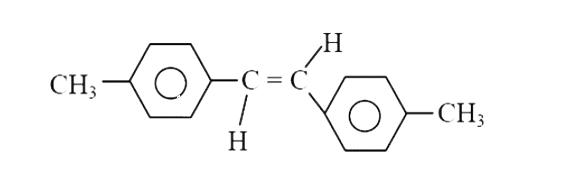
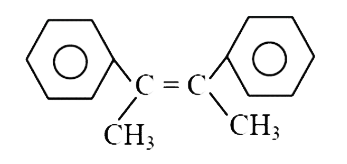
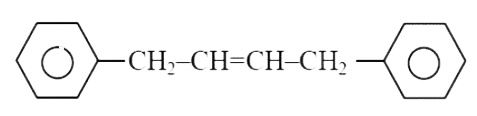
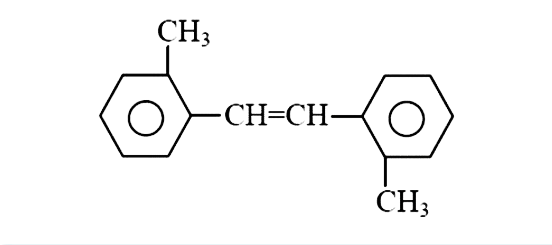
An alkene `(A)C_(16)H_(16)` on ozonolysis gives only one product `(B)(C_(8)H_(8)O)`. Compound (B) on reaction with `NH_(2)OH` followed by reaction with `H_(2)SO_(4), Delta` gives N - methyl benzamide the compound 'A' is -

A

B

C

D

Text Solution

AI Generated Solution

The correct Answer is:

To determine the compound (A) from the given information, we will follow these steps: ### Step 1: Analyze the information given We know that compound (A) is an alkene with the formula \(C_{16}H_{16}\). Upon ozonolysis, it yields compound (B) with the formula \(C_{8}H_{8}O\). Compound (B) further reacts with hydroxylamine (\(NH_2OH\)) and then with sulfuric acid (\(H_2SO_4\)) to produce N-methyl benzamide. ### Step 2: Calculate the degree of unsaturation for compound (B) The degree of unsaturation (DU) can be calculated using the formula: \[ DU = \frac{2C + 2 - H}{2} \] For compound (B) \(C_{8}H_{8}O\): - \(C = 8\) - \(H = 8\) Substituting the values: \[ DU = \frac{2(8) + 2 - 8}{2} = \frac{16 + 2 - 8}{2} = \frac{10}{2} = 5 \] This indicates that compound (B) has 5 degrees of unsaturation. ### Step 3: Identify the structure of compound (B) Given that compound (B) has a degree of unsaturation of 5, it likely contains a benzene ring (which accounts for 1 degree of unsaturation) and additional double bonds. Since it has a total of 8 carbon atoms, we can assume that it has a structure that includes a benzene ring and additional carbon atoms with double bonds. ### Step 4: Determine the structure of compound (B) The structure of compound (B) can be deduced as follows: - The benzene ring contributes 6 carbons. - The remaining 2 carbons can be connected through a double bond, leading to a structure like acetophenone (\(C_6H_5COCH_3\)). ### Step 5: Confirm the reaction to N-methyl benzamide When compound (B) (assumed to be acetophenone) reacts with hydroxylamine, it forms an oxime. Upon heating with sulfuric acid, this oxime can rearrange to form N-methyl benzamide. ### Step 6: Determine the structure of compound (A) Since compound (A) is an alkene that yields two equivalents of compound (B) upon ozonolysis, we can deduce that compound (A) must be a symmetrical alkene that can break down into two molecules of acetophenone. The likely structure for compound (A) is: \[ \text{(C}_6\text{H}_5\text{)}_2\text{C}=\text{C}(\text{C}_6\text{H}_5) \] This structure consists of two phenyl groups attached to a double bond. ### Final Answer The compound (A) is: \[ \text{1,2-Diphenylethylene (or stilbene)} \] ---
Promotional Banner

Similar Questions

Explore conceptually related problems

An organic compound (A), C_(8)H_(4) O_(3) in dry benzene in the presene of anhydorus AlCl_(3) gives compound (B) . Compound (B) on treatment with PCl_(5) followed by reaction with H_(2)//Pd (BaSO_(4)) gives compound (C) which on reaction with hydrazine gives a cyclised compound (D),(C_(14) H_(10) N_(2)) Idenyify (A),(B),(C) and (D) . Explain the formation of (D) from (C) .

An organic compound X(C_5H_10) on ozonolysis gives Y & Z. The product mixture Y and Z on reaction with NH_2-OH gives four oximes.The structure of X is

Compound (x)(m.f=C_(7)H_(8)N) , on reaction with NaNO_(2) and conc. HCl at O^(@)C followed by beta - naphthol gives orange coloured dye. Compound (x) is :

An organic compound with molecular formula C_6 H_(12) upon ozonolysis gives only acetone as the product. The compound is :

A hydrocarbon 'A' (C_(4)H_(8)) on reaction HCl gives a compound 'B', (C_(4)H_(9)Cl) which on reaction with 1 mol of NH_(3) gives compounds 'C' (C_(4)H_(11)N) . On reacting with NaNO_(2) and HCl followed by treatment with water compound 'C' yields an optically active alcohol, 'D'. Ozonolysis of 'A' given 2mols of acetyldehyde. Identify compound 'A' to 'D'. Explain the reaction involved.

Give the products of the reaction with conc. H_(2)SO_(4) of : a. b. c. d. 1- Methyl cyclohexanol

Compound (A)(C_(8)H_(12)) on oxidation gives an acid B(C_(4)H_(6)O_(2)) . One mole of compound (A) reacts with 3 mol of H_(2) in the presence of Pt catalyst to give octane. Identify compound (A) .

A compound (A) C_(5)H_(10) Cl_(2) on hydrolysis gives C_(5)H_(10)O which reacts with NH_(2)OH , forms iodoform but does not give Fehling test (A) is :

A compound 'X' on ozonolysis followed by reduction gives an aldehyde, C_(2)H_(4)O and 2-butanone. Compound 'X' is:
