Home
Class 12
PHYSICS
A cylindrical conductor has length l and...

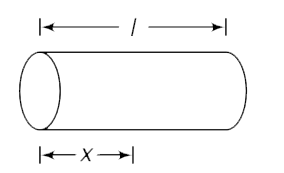
A cylindrical conductor has length `l` and area of cross section A. Its conductivity changes with distance `(x)` from one of its ends as `sigma = sigma_(0) (l)/(x). [sigma_(0) "is a constant"]`. Calculate electric field inside the conductor as a function of `x`, when a cell of emf V is connected across the ends.

A

`(2sqrtL)/(3Asigma_(0))`

B

`(3sqrtL)/(3Asigma_(0))`

C

`(sqrtL)/(3Asigma_(0))`

D

`(4sqrtL)/(3Asigma_(0))`

Text Solution

Verified by Experts

The correct Answer is:

A
Promotional Banner

Similar Questions

Explore conceptually related problems

A cylindrical conductor has uniform cross-section. Resistivity of its material increase linearly from left end to right end. If a constant current is flowing through it and at a section distance x from left end, magnitude of electric field intensity is E , which of the following graphs is correct

A cylindrical conductor has uniform cross-section. Resistivity of its material increase linearly from left end to right end. If a constant current is flowing through it and at a section distance x from left end, magnitude of electric field intensity is E , which of the following graphs is correct

What will be the magnitude and polarity of induced emf across the rod, if it is rotating about an axis at a distance (L)/(4) from one of its ends.

A conductor with a cavity is charged positively and its surface charge density is sigma . If E and V represent the electric field and potential, then inside the cavity

A rod of length L is of non uniform cross-section. Its mass per unit length varies linearly with distance from left end. Then its centre of mass from left end is at a distance. (Take linear density at left end=0).

An electrical conductor designed to carry large currents has a circular cross-section 2.50 mm in diameter and is 14.0 m long. The resistance between its ends is 0.104 Omega . (a) What is the resistivity of the material? (b) If the electric field magnitude in the conductor is 1.28V//m , what is the total current? (c) If the material has 8.5 x 10^28 free electrons per cubic metre, find the average drift speed under the conditions of part (b).

The mass per unit length (lambda) of a non-uniform rod varies linearly with distance x from its one end accrding to the relation, lambda = alpha x , where alpha is a constant. Find the centre of mass as a fraction of its length L.

The resistivity of cylindrical conductor carrying steady current along its length varies linearly with the distance from the current carrying end as given by rho=rho_(0)(1+(x)/(l)) where l is the length of the conductor and x is the distance from the current entry and. rho_(o) is a positive constant.

A long, thick straight conductor of radius R carries current I uniformly distributed in its cross section area.The ratio of energy density of the magnetic field at distance R//2 from surface inside the conductor and outside the conductor is:

The cross-section area and length of cylindrical conductor are A and l respectively. The specific conductivity varies as sigma(x)=sigma_(0)(l)/(sqrt(x)) , where x is the distance along the axis of the cylinder from one of its ends. Compute the resistance of the system along the cylindrical axis.
