Home
Class 12
PHYSICS
In a spherical distribution , the charge...

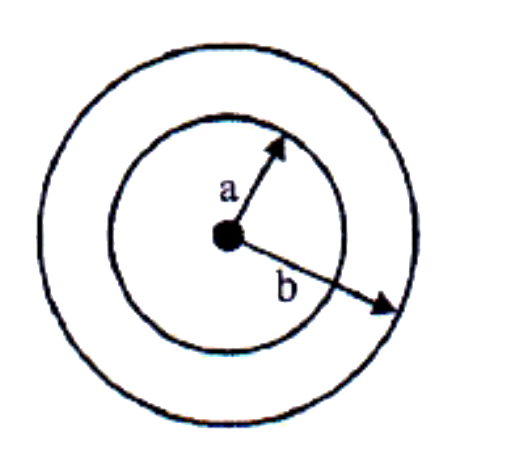
In a spherical distribution , the charge density varies as `rho(r)=A//r " for " a lt r lt b` (as shown) where A is constant . A point charge Q lies at the centre of the sphere at r = 0 . The electric filed in the region `altrltb` has a constant magnitude for

A

A = 0

B

A = Q

C

`A=(Q)/(2Pia^2)`

D

`A=(Q)/(4Pia^2)`

Text Solution

Verified by Experts

The correct Answer is:

C
Promotional Banner

Similar Questions

Explore conceptually related problems

The region between two concentric spheres of radii 'a' and 'b', respectively (see figure), have volume charge density rho=A/r , where A is a constant and r is the distance from the centre. At the centre of the spheres is a point charge Q. The value of A such that the electric field in the region between the spheres will be constant, is:

The region between two concentric spheres of radii 'a' and 'b', respectively (see figure), have volume charge density rho=A/r , where A is a constant and r is the distance from the centre. At the centre of the spheres is a point charge Q. The value of A such that the electric field in the region between the spheres will be constant, is:

A solid non conducting sphere of radius R has a non-uniform charge distribution of volume charge density, rho=rho_(0)r/R , where rho_(0) is a constant and r is the distance from the centre of the sphere. Show that : (i) the total charge on the sphere is Q=pirho_(0)R^(3) (ii) the electric field inside the sphere has a magnitude given by, E=(KQr^(2))/R^(4)

Let there be a spherically symmetric charge distribution with charge density varying as rho(r)=rho(5/4-r/R) upto r=R , and rho(r)=0 for rgtR , where r is the distance from the origin. The electric field at a distance r(rltR) from the origin is given by

A conducting shell of radius R carries charge–Q. A point charge +Q is placed at the centre of shell. The electric field E varies with distance r (from the centre of the shell) as :

An insulating solid sphere of radius R has a uniformly positive charge density rho . As a result of this uniform charge distribution there is a finite value of electric potential at the centre of the sphere, at the surface of the sphere and also at a point out side the sphere. The electric potential at infinity is zero. Statement-1: When a charge 'q' is taken from the centre to the surface of the sphere, its potential energy changes by (qrho)/(3 in_(0)) Statement-2 : The electric field at a distance r (r lt R) from the centre of the the sphere is (rho r)/(3in_(0))

A solid insulating sphere of radius R has a nonuniform charge density that varies with r according to the expression rho = Ar^2 , where A is a constant and rltR is measured from the centre of the sphere. Show that (a) the magnitude of the electric field outside (rgtR) the sphere is E = AR^5//5epsilon_0r^2 and (b) the magnitude of the electric field inside (rltR) the sphere is E = Ar^3//5epsilon_0 .

A solid conducting sphere of radius r is having a charge of Q and point charge q is a distance d from the centre of sphere as shown. The electric potential at the centre of the solid sphere is :

A conducting shell of radius R carries charge -Q . A point charge +Q is placed at the centre. The electric field E varies with distance r (from the centre of the shell) as

Let there be a spherical symmetric charge density varying as p(r )=p_(0)(r )/(R ) upto r = R and rho(r )=0 for r gt R , where r is the distance from the origin. The electric field at on a distance r(r lt R) from the origin is given by -
