Home
Class 12
PHYSICS
A uniform solid cylinder of density 0.8g...

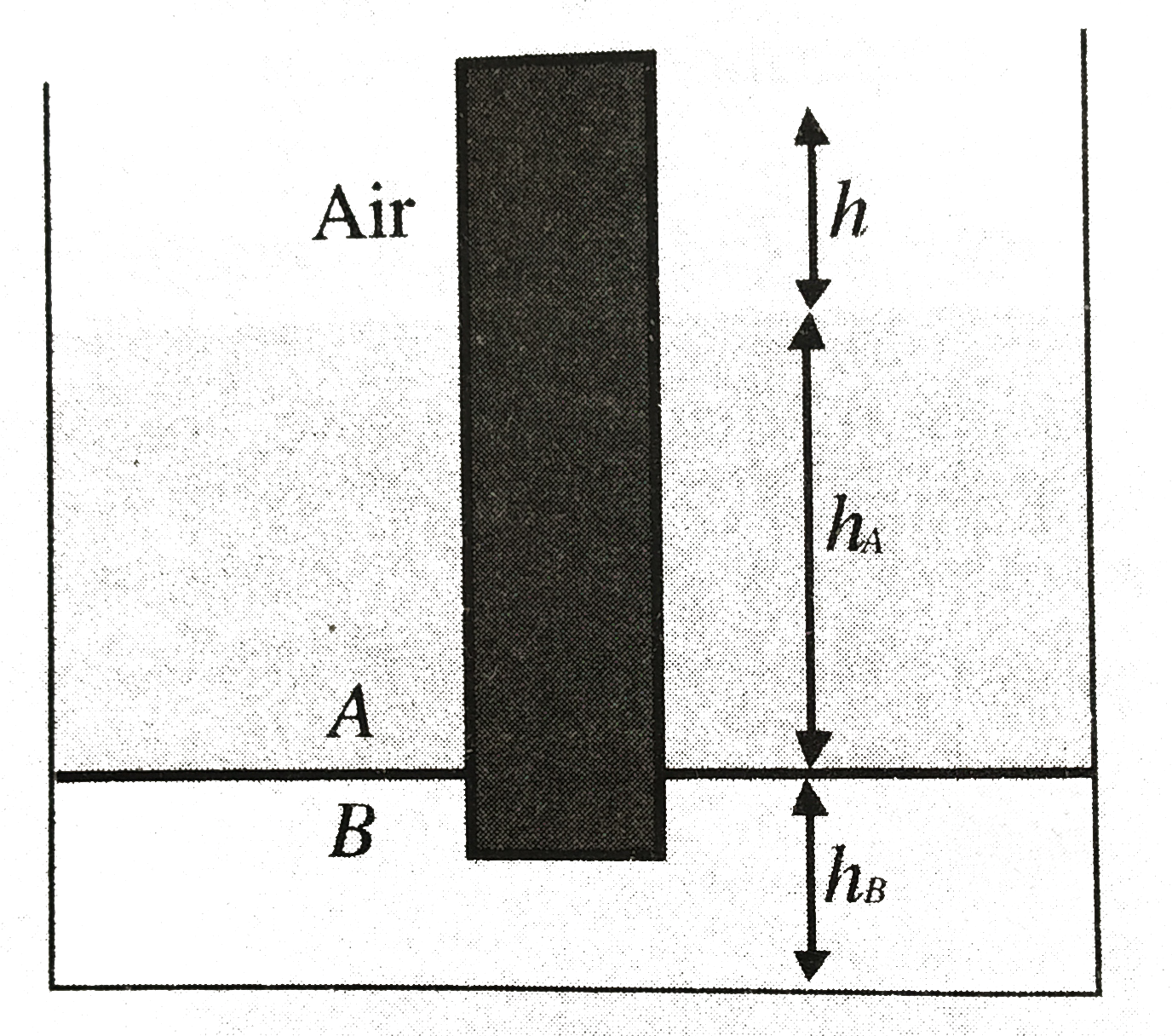
A uniform solid cylinder of density `0.8g//cm^(3)` floats in equilibrium in a combination of two non mixin liquids `A` and `B` with its axis vertical. The densities of liquids `A` and `B` are `0.7g//cm^/(3)` and `1.2g//cm^(3)`, respectively. The height of liquid `A` is `h_(A)=1.2cm.` The length of the part of the cylinder with liquid `B` is `h_(B)=0.8 cm.`

a. Find the total force exerted by liquid `A` on the cylinder.
Find `h` the length of part of the cylinder in air.
c.The cylinder is depressed in such a way that its top surface is just below the upper surface of liquid `A` and is then released. Find the aceleration of the cylinder immediately just after it is released.

A

zero

B

84 N

C

96 N

D

40 N

Text Solution

Verified by Experts

The correct Answer is:

A
Promotional Banner

Similar Questions

Explore conceptually related problems

A uniform solid cylinder of density 0.8g//cm^3 floats in equilibrium in a combination of two non-mixing liquids A and B with its axis vertical. The densities of the liquids A and B are 0.7g//cm^3 and 1.2g//cm^3 , respectively. The height of liquid A is h_A=1.2cm. The length of the part of the cylinder immersed in liquid B is h_B=0.8cm . (a) Find the total force exerted by liquid A on the cylinder. (b) Find h, the length of the part of the cylinder in air. (c) The cylinder is depressed in such a way that its top surface is just below the upper surface of liquid A and is then released. Find the acceleration of the cylinder immediately after it is released.

A uniform solid cylinder of density 0.8g//cm^3 floats in equilibrium in a combination of two non-mixing liquids A and B with its axis vertical. The densities of the liquids A and B are 0.7g//cm^3 and 1.2g//cm^3 , respectively. The height of liquid A is h_A=1.2cm. The length of the part of the cylinder immersed in liquid B is h_B=0.8cm . (a) Find the total force exerted by liquid A on the cylinder. (b) Find h, the length of the part of the cylinder in air. (c) The cylinder is depressed in such a way that its top surface is just below the upper surface of liquid A and is then released. Find the acceleration of the cylinder immediately after it is released.

A uniform solid cylinder of density 0.8g//cm^3 floats in equilibrium in a combination of two non-mixing liquids A and B with its axis vertical. The densities of the liquids A and B are 0.7g//cm^3 and 1.2g//cm^3 , respectively. The height of liquid A is h_A=1.2cm. The length of the part of the cylinder immersed in liquid B is h_B=0.8cm . (a) Find the total force exerted by liquid A on the cylinder. (b) Find h, the length of the part of the cylinder in air. (c) The cylinder is depressed in such a way that its top surface is just below the upper surface of liquid A and is then released. Find the acceleration of the cylinder immediately after it is released.

A solid cylinder of length L is in equilibrium in two different liquid A and B as shown in the figure.The density of liquid A (3ρ)/2 and liquid B is 3ρ.The density of cylinder is

The apparent depth of a liquid in a vessel is 15 cm, when its real depth is 20 cm. find the refractive index of the liquid.

Two solids A and B of density 2.5 g cm^(-3) and 0.80g cm^(-3) are placed in a liquid L of density 1.2 g cm^(-3) Which solid is likely to float and why?

Two immiscible of densities 2.5g//cm^(3) and 0.8g//cm^(3) are taken in the ratio of their masses as 2:3 respectively find the average density of the liquid conbination.

A body of density 2.5 g//cm^(3) is let free in a liquid of density 1.25 g//cm^(3) . The downward acceleration of the of the body while sinking in the liquid is . _______

Two miscible liquids of densities 1.2gm//cm and 1.4gm//cm aer mixed with a proportion ratio of their volumes equal to 2.5: what is the density of redulting liquid?

A block of wood of density 0.8 g cm^(-3) has a volume of 60 cm^3 . The mass of block will be :
