Home
Class 12
PHYSICS
Two cylindrical rods of same cross-sect...

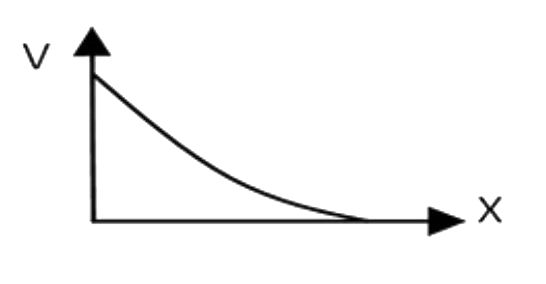
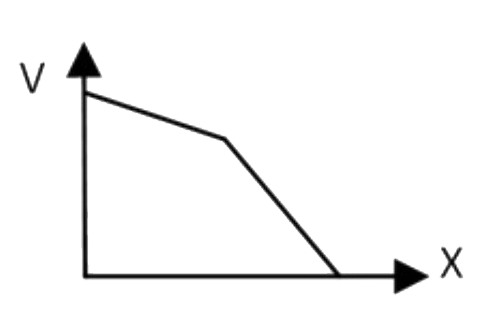
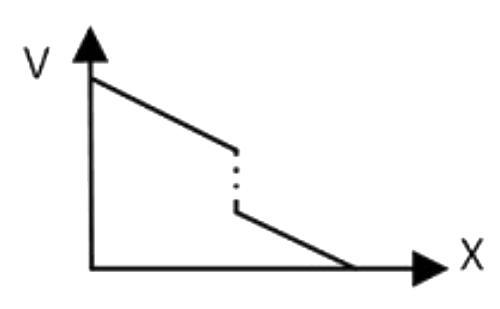
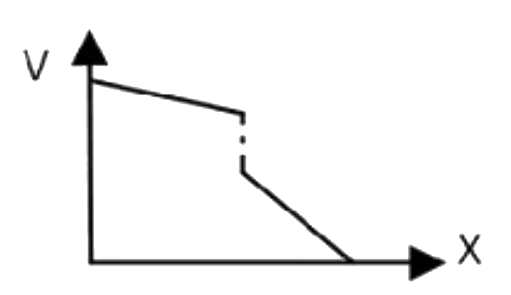
Two cylindrical rods of same cross-section area and same length are connected in series to an ideal cell as shown.The resistivity of left rod is `rho` and that if right rod is `2 rho` Then the variation of potential and electric field at any point `P` distant `x` from left end of combined rod system are given by

A

B

C

D

Text Solution

AI Generated Solution

The correct Answer is:

To solve the problem, we need to analyze the two cylindrical rods connected in series, taking into account their resistivities and how they affect the electric field and potential along the rods. ### Step-by-Step Solution: 1. **Identify the Parameters**: - Let the length of each rod be \( L \). - The resistivity of the left rod is \( \rho \). - The resistivity of the right rod is \( 2\rho \). - The cross-sectional area \( A \) of both rods is the same. 2. **Calculate the Resistance of Each Rod**: - The resistance \( R \) of a rod is given by the formula: \[ R = \frac{\rho L}{A} \] - For the left rod: \[ R_1 = \frac{\rho L}{A} \] - For the right rod: \[ R_2 = \frac{2\rho L}{A} \] 3. **Total Resistance in Series**: - The total resistance \( R_{total} \) of the two rods in series is: \[ R_{total} = R_1 + R_2 = \frac{\rho L}{A} + \frac{2\rho L}{A} = \frac{3\rho L}{A} \] 4. **Current Through the Rods**: - If an ideal cell of voltage \( V \) is connected across the series combination, the current \( I \) through the rods can be calculated using Ohm's law: \[ I = \frac{V}{R_{total}} = \frac{V A}{3\rho L} \] 5. **Electric Field in Each Rod**: - The electric field \( E \) in a rod is given by: \[ E = \frac{V}{L} \] - For the left rod: \[ E_1 = \frac{I R_1}{L} = \frac{I \cdot \frac{\rho L}{A}}{L} = \frac{I \rho}{A} \] - For the right rod: \[ E_2 = \frac{I R_2}{L} = \frac{I \cdot \frac{2\rho L}{A}}{L} = \frac{2I \rho}{A} \] 6. **Comparison of Electric Fields**: - Since \( E_2 = 2E_1 \), the electric field is greater in the right rod than in the left rod. 7. **Potential Variation**: - The potential drop across each rod can be calculated as: - For the left rod: \[ V_1 = E_1 \cdot L \] - For the right rod: \[ V_2 = E_2 \cdot L \] 8. **Total Potential**: - The total potential across both rods is: \[ V = V_1 + V_2 \] 9. **Conclusion**: - The variation of potential and electric field at any point \( P \) (distance \( x \) from the left end) will show that the electric field is greater in the right rod, and the potential will be continuous across the junction of the two rods.
Promotional Banner

Similar Questions

Explore conceptually related problems

A conductor of resistivity rho and resistance R, as shown in the figure, is connected across a battery of emf V. Its radius varies from a at left end to b at right end. The electric field at a point P at distance x from left end of it is

Two rods A and B of same cross-sectional area A and length l are connected in series between a source (T_(1)=100^(@)C) and a sink (T_(2)-0^(@)C) as shown in figure. The rod is laterally insulated. The ratio of the thermal resistance of the rods is

A cylindrical solid of length L and radius a is connected across a source of emf V and negligible internal resistance shown in figure. The resistivity of the rod at point P at a distance x from left end is given by rho=bx (where b is a positive constant). Find the electric field at point P.

Two rods A and B of same cross-sectional area A and length l are connected in series between a source (T_(1)=100^(@)C) and a sink (T_(2)-0^(@)C) as shown in figure. The rod is laterally insulated. If T_(A) and T_(B) are the temperature drops across the rod A and B, then

Three rods of same cross-section but different length and conductivity are joined in series . If the temperature of the two extreme ends are T_(1) and T_(2) (T_(1)gtT_(2)) find the rate of heat transfer H.

Two cylindrical rods of uniform cross-section area A and 2A , having free electrons per unit volume 2n and n respectively are joined in series. A current I flows through them in steady state. Then the ratio of drift velocity of free electron in left rod to drift velocity of electron in the right rod is ((v_(L))/(v_(R))) is

Two rods A and B of same length and cross-sectional area are connected in series and a temperature difference of 100^@C is maintained across the combination as shoen in Fig. If the thermal conductivity of the rod A is 3 k and that of rod B is k, Then i.Determine the thermal resistance of each rod. ii. determine the heat current flowing through each rod. iii. determine the heat current flowing through each rod. iv. plot the variation of temperature along the length of the rod.

Two rods A and B of same cross-sectional area A and length l are connected in series between a source (T_(1)=100^(@)C) and a sink (T_(2)-0^(@)C) as shown in figure. The rod is laterally insulated. If G_(A) and G_(B) are the temperature gradients across the rod A and B, then

A rod of length L and cross-section area A lies along the x-axis between x=0 and x=L . The material obeys Ohm's law and its resistivity varies along the rod according to rho(x) = rho_0 epsilon^(-x//L) . The end of the rod x=0 is at a potential V_0 and it is zero at x=L . (a) Find the total resistance of the rod and the current in the wire. (b) Find the electric potential in the rod as a function of x .

Statement I: Two solid cylindrical rods of identical size and different thermal conductivity K_1 and K_2 are connected in series. Then the equivalent thermal conductivity of two rods system is less than that value of thermal conductivity of either rod. Statement II: For two cylindrical rods of identical size and different thermal conductivity K_1 and K_2 connected in series, the equivalent thermal conductivity K is given by (2)/(K)=(1)/(K_1)+(1)/(K_2)
