Home
Class 12
PHYSICS
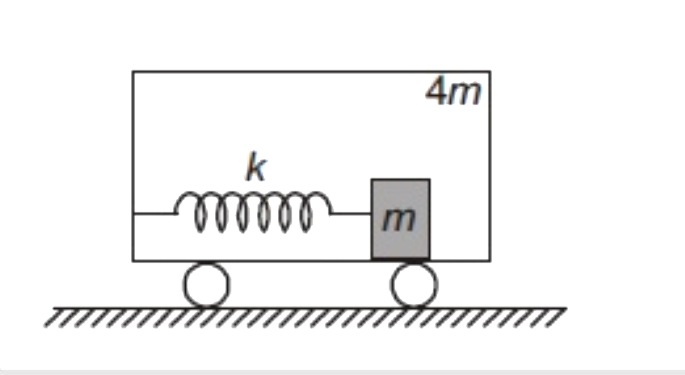
A block of mass m is attached to a cart ...

A block of mass m is attached to a cart of mass 4m through spring of spring constant k as shown in the figure. Friction is absent everywhere. The time period of oscillations of the system, when spring is compressed and then released, is

A

`pi sqrt((m)/(k))`

B

`2pi sqrt((m)/(k))`

C

`2pi sqrt((5m)/(2k))`

D

`4pi sqrt((m)/(5k))`

Text Solution

Verified by Experts

The correct Answer is:

D
Promotional Banner

Similar Questions

Explore conceptually related problems

A uniform disc of mass m is attached to a spring of spring constant k as shown in figure and there is sufficient friction to prevent slipping of disc. Time period of small oscillations of disc is:

A system of springs with their spring constants are as shown in figure. What is the frequency of oscillations of the mass m ?

A block of mass 0.2 kg is attached to a mass less spring of force constant 80 N/m as shown in figure. Find the period of oscillation. Take g=10 m//s^(2) . Neglect friction

A block of mass 0.2 kg is attached to a mass less spring of force constant 80 N/m as shown in figure. Find the period of oscillation. Take g=10 m//s^(2) . Neglect friction

A spring of force constant 'k' is cut into four equal parts one part is attached with a mass m. The time period of oscillation will be

A body of mass m is suspended from three springs as shown in figure. If mass m is displaced slightly then time period of oscillation is

A block of mass m hangs from a vertical spring of spring constant k. If it is displaced from its equilibrium position, find the time period of oscillations.

A block of mass m is suspended by different springs of force constant shown in figure.

A block of mass m compresses a spring iof stifffness k through a distacne l//2 as shown in the figure .If the block is not fixed to the spring the period of motion of the block is

A block of mass m is connected to another .block of mass M by a massless spring of spring constant k. A constant force f starts action as shown in figure, then:
