Home
Class 12
CHEMISTRY
Metal 'M' forms a carbonyl compound in w...

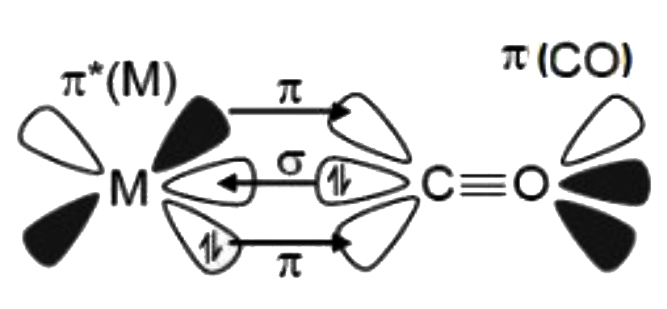
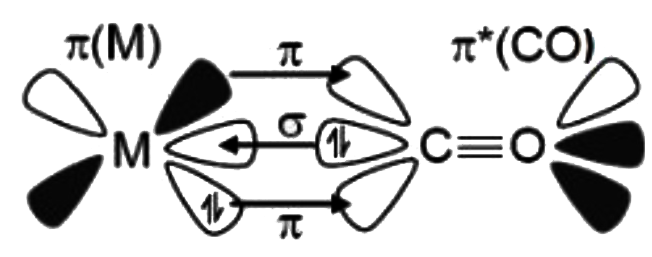
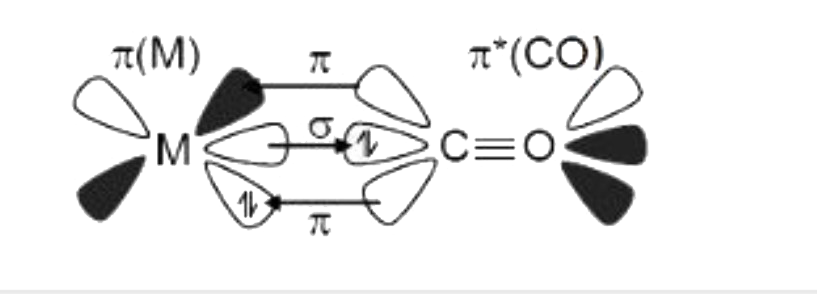
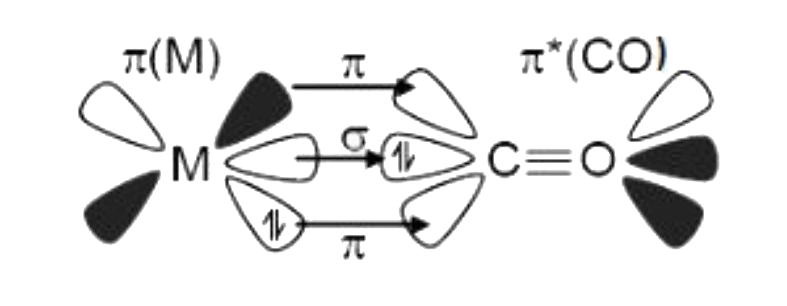
Metal 'M' forms a carbonyl compound in which it is present in its lower valance state. Which of the following bonding is possible in this metal carbonyl?

A

B

C

D

Text Solution

AI Generated Solution

The correct Answer is:

To solve the question regarding the bonding in a metal carbonyl where the metal 'M' is in its lower valence state, we will analyze the bonding interactions that occur between the metal and the carbonyl ligand (CO). ### Step-by-Step Solution: 1. **Understanding Metal Carbonyls**: - Metal carbonyls are complexes formed between a metal and carbon monoxide (CO) ligands. In these complexes, CO acts as a ligand that can donate electron density to the metal. 2. **Identifying the Valence State of Metal 'M'**: - The question states that metal 'M' is in its lower valence state. This is important because it influences the types of bonds that can form between the metal and the CO ligands. 3. **Sigma Bond Formation**: - The carbonyl carbon has a lone pair of electrons that can be donated to the vacant d-orbitals of the metal. This results in the formation of a sigma (σ) bond. - The interaction can be represented as: \[ \text{CO (lone pair)} \rightarrow \text{Metal (vacant d-orbital)} \] 4. **Pi Bond Formation**: - In addition to sigma bonding, there is also the possibility of pi (π) back-bonding. This occurs when the filled d-orbitals of the metal can donate electron density to the empty π* (anti-bonding) orbitals of the CO. - The interaction can be represented as: \[ \text{Metal (filled d-orbital)} \rightarrow \text{CO (π*)} \] 5. **Analyzing the Options**: - The question asks which bonding is **not** possible in this metal carbonyl. We need to evaluate the provided options based on our understanding of sigma and pi bonding. - **Option A**: If it suggests that the metal donates electrons to a π* orbital of the metal itself, this would be incorrect as back-bonding occurs with the CO's π* orbital. - **Option B**: If it describes the correct sigma and pi bonding interactions, this is a valid bonding scenario. - **Option C**: If it suggests incorrect sigma bonding interactions, this would also be invalid. - **Option D**: Similar to option C, if it describes incorrect interactions, it would be invalid. 6. **Conclusion**: - After evaluating the bonding interactions and the options, we conclude that the bonding that is **not** possible is the one where the metal donates electrons to its own π* orbital, as this does not occur in metal carbonyls. ### Final Answer: The bonding that is **not** possible in this metal carbonyl is the one where the metal donates electrons to its own π* orbital. ---
Promotional Banner

Similar Questions

Explore conceptually related problems

Which of the following statement is correct regarding metal carbonyl ?

In which of the following compounds , back bonding is possible

Which of the following carbonyl compounds is most polar ?

The complex compound in which metal is not present in zero oxidation state?

Which of the following does not apply to bonding in metals ?

In Which of the following metal to metal bond is present?

Which of the following metals is present in chlorophyll ?

Which of the following does not have a metal carbon bond?

Which of the following is not a metal carbonyl?

In which of the following metal to metal bond is present ?
