Home
Class 12
PHYSICS
Two blocks P and Q of masses 0.3 kg and ...

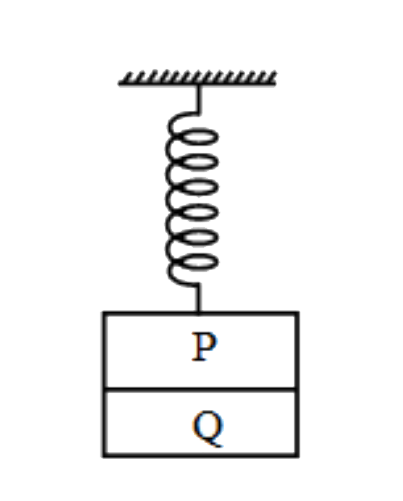
Two blocks P and Q of masses 0.3 kg and 0.4 kg respectively are stuck to each other by some weak glue as shown in the figure. They hand together at the end of a spring with a spring constant `"k = 200 N m"^(-1)`. The block Q suddenly falls free due to failure of glue, then find the maximum kinetic energy of the block P during subsequent motion (in mJ).

Text Solution

Verified by Experts

The correct Answer is:

40
Promotional Banner

Similar Questions

Explore conceptually related problems

Two block of mass 4 kg and 5 kg attached a light spring are suspended by a string as shown in figure. Find acceleration of block 5 kg and 4 kg just after the string is cut.

Two blocks of masses 3kg and 6kg respectivley are placed on a smooth horizontal surface. They are connected by a light spring of force constant k=200N//m . Initially the spring is unstretched. The indicated velocities are imparted to the blocks. Find the maximum extension of the spring.

Two blocks of masses 3kg and 6kg respectivley are placed on a smooth horizontal surface. They are connected by a light spring of force constant k=200N//m . Initially the spring is unstretched. The indicated velocities are imparted to the blocks. Find the maximum extension of the spring.

In the figure all spring are identical having spring constant k and mass m each The block also mass m The frequency of oscillation of the block is

Two blocks of mass 2kg and 5kg are given speed as shown in the figure. System is lying on a frictionless surface and the blocks are connected by a massless spring if spring constant 35 N/m . Find the maximum compression in the spring.

Two block A and B of masses m_(1) = 3kg and m_(2) = 6kg respectively are connected with each other by a spring of force constant k = 200 N//m as shown in figure. Blocks are pulled away from each other by x_(0) = 3cm and then released. When spring is in its natural length and block are moving towards each other, another block C of mass m = 3kg moving with velocity v_(0) = 0.4m//s (towards right) collides with A and gets stuck to it. Neglecting friction, calculate (a) velocity v_(1) and v_(2) of the blocks A and B respectively just before collision and their angular frequency . (b) velocity of centre of mass of the system, after collision, ( c) amplitude of oscillation of combined body, (d) loss of energy during collision.

A block attached with an ideal spring is kept on a smooth horizontal surface. Now the free end of the spring is pulled with a constant velocity u horizontally. Then the maximum energy stored in the spring and bock system during subsequent motion is :

A block of mass m compresses a spring iof stifffness k through a distacne l//2 as shown in the figure .If the block is not fixed to the spring the period of motion of the block is

Two blocks of mass 2 kg and 4 kg are accelerated with same acceleration by a force 10 N as shown in figure on a smooth horizontal surface. Then the spring force between the two blocks will be (spring is massless)

Two blocks of masses 6 kg and 3 kg are attached to the two ends of a massless spring of spring constant 2 pi^(2) N//m . If spring is compressed and released on a smooth horizontal surface then find the time period (in seconds) of each block.
