Home
Class 12
PHYSICS
A solid cylinder is kept on one edge of ...

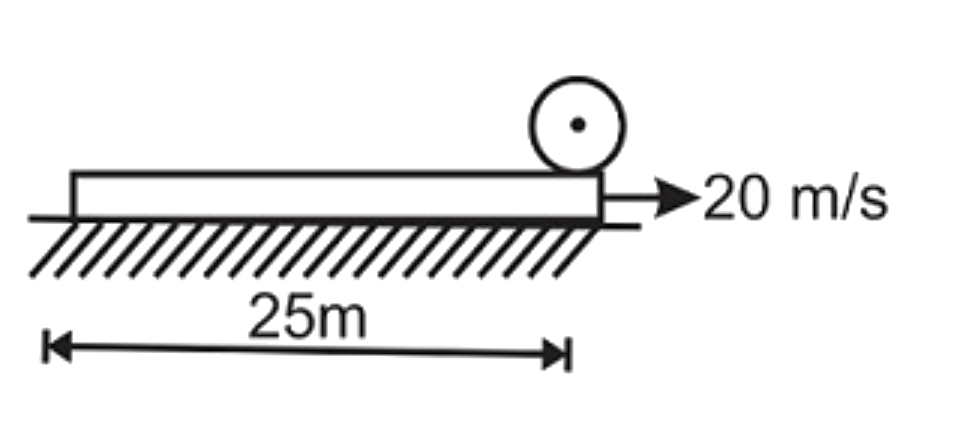
A solid cylinder is kept on one edge of a plank of same mass and length 25 m placed on a smooth surface as shown in the figure. The coefficient of friction between the cylinder and the plank is 0.5. The plank is given a velocity of `20ms^(-1)` towards right. Find the time (in S) after which plank any cylinder will separate. `[g=10ms^(-2)]`

Text Solution

Verified by Experts

The correct Answer is:

2
Promotional Banner

Similar Questions

Explore conceptually related problems

A cylinder of mass m is kept on the edge of a plank of mass 2m and length 12 m , which in turn is kept on smooth ground. Coefficient of friction between the plank and the cylinder is 0.1 . The cylinder is given an impulse, which imparts it a velocity 7 ms^(-1) but no angular velocity. Find the time after which the cylinder falls off the plank.

A block A of mass m is placed over a plank B of mass 2m plank B is placed over a smooth horizontal surface .The coefficient of friction between A and B is 0.4 Block A is given a velocity v_(0) toward right Find acceleration (in ms^(-2) of B relative to A

A block A of mass m is placed over a plank B of mass 2m. Plank B is placed over a smooth horizontal surface. The coefficient of friction between A and B is (1)/(2) block A is given a velocity v_(0) towards right. Accelration of B relative to A is

A bolck of mass m =2 kg is placed on a plank of mass M = 10 kg, which is placed on a smooth horizontal plane as shown in the figure. The coefficient of friction between the block and the plank is mu=(1)/(3) . If a horizontal force F is applied on the plank, then the maximum value of F for which the block and the plank move together is (g=10m//s^(2))

A block of mass m is gently placed over a massive plank moving horizontal over a smooth surface with velocity 10 ms^(-1) . The coefficient of friction between the block and the plank is 0.2. The distance travelled by the block till it slides on the plank is [g = 10 ms^(-2)]

A block is kept on a rough horizontal plank. The coefficient of friction between the block and the plank is 1/2 . The plank is undergoing SHM of angular frequency 10 rad/s. The maximum amplitude of plank in which the block does not slip over the plank is (g= 10 m/ s^(2) )

Two block of masses m1 and m2 are connected with a massless unstretched spring and placed over a plank moving with an acceleration 'a' as shown in figure. The coefficient of friction between the blocks and platform is mu

Find the acceleration of the cylinder of mass m and radius R and that of plank of mass M placed on smooth surface if pulled with a force F as shown in figure. Given that sufficient friction is present between cylinder and the plank surface to prevent sliding of cylinder.

A block of mass m=2kg of shown dimensions is placed on a plank of mass M = 6Kg which is placed on smooth horizontal plane. The coefficient of friction between the block and the plank is mu=1/3 . If a horizontal froce F is applied on the plank, then find the maximum value of F (in N) for which the block and the plank move together

A block of negligible size and mass 2kg is placed above a plank of mass 4kg and length 16m as shown in figure. A force of 44N is applied on the lower block as shown in the figure. The ground is smooth, coefficient of friction between upper and lower block is 0.2. Find the time after which the upper block will fall over.
