Home
Class 12
CHEMISTRY
The correct orientation of dipoles in py...

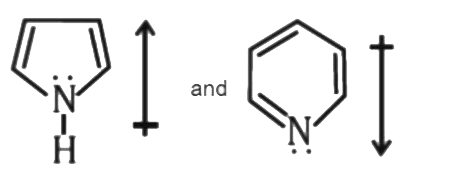
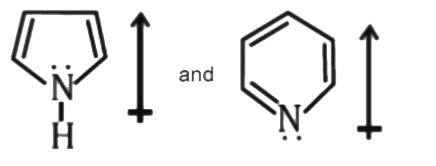
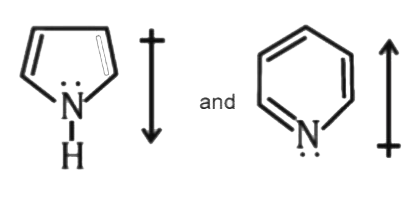
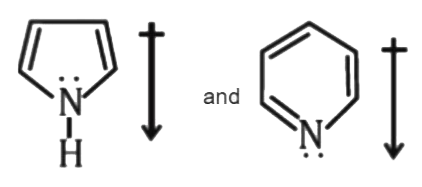
The correct orientation of dipoles in pyrrole and pyridine is

A

B

C

D

Text Solution

AI Generated Solution

The correct Answer is:

To determine the correct orientation of dipoles in pyrrole and pyridine, we need to analyze the resonance structures of both compounds and the resulting charge distributions. Here’s a step-by-step breakdown of the solution: ### Step 1: Understand the Structures of Pyrrole and Pyridine - **Pyrrole** is a five-membered aromatic ring containing one nitrogen atom. - **Pyridine** is a six-membered aromatic ring also containing one nitrogen atom. ### Step 2: Draw the Resonance Structures of Pyrrole 1. Start by drawing the basic structure of pyrrole: - It has a nitrogen atom in the ring with two hydrogens attached to it. 2. Identify the lone pair on the nitrogen atom: - The lone pair can participate in resonance by forming a double bond with one of the carbons in the ring. 3. Shift the double bond: - When the lone pair on nitrogen forms a double bond with a carbon, it creates a negative charge on another carbon in the ring. 4. Draw the resonance structures: - Continue shifting the double bonds to show the movement of the negative charge around the ring. ### Step 3: Determine the Charge Distribution in Pyrrole - After analyzing the resonance structures, you will find that the nitrogen atom carries a partial positive charge (due to the loss of its lone pair) and the ring carries a partial negative charge. - Therefore, the dipole moment in pyrrole points from the nitrogen (positive) to the ring (negative), which means the dipole is directed upwards. ### Step 4: Draw the Resonance Structures of Pyridine 1. Draw the basic structure of pyridine: - It has a nitrogen atom in the ring with one hydrogen attached. 2. Identify the double bonds in the ring: - The nitrogen atom is part of the aromatic system but does not have a lone pair that can participate in resonance like in pyrrole. 3. Shift the double bonds: - The double bond adjacent to the nitrogen can shift towards the nitrogen, creating a partial negative charge on the nitrogen and a partial positive charge on the adjacent carbon. 4. Draw the resonance structures: - Show the movement of the double bonds and the resulting charge distribution. ### Step 5: Determine the Charge Distribution in Pyridine - In pyridine, the nitrogen atom carries a partial negative charge, while the ring has a partial positive charge. - Thus, the dipole moment in pyridine points from the ring (positive) to the nitrogen (negative), which means the dipole is directed downwards. ### Step 6: Conclusion - From the analysis, we find: - **Pyrrole:** Dipole moment points upwards (from nitrogen to the ring). - **Pyridine:** Dipole moment points downwards (from the ring to nitrogen). - Therefore, the correct orientation of dipoles is that in pyrrole the dipole points upwards, and in pyridine, it points downwards. ### Final Answer The correct option is **A**: Pyrrole has a dipole moment pointing upwards, and pyridine has a dipole moment pointing downwards. ---
Promotional Banner

Similar Questions

Explore conceptually related problems

The correct order of dipole moment is :

The correct order of dipole moment is :

The only correct combination for pyrrole is

Correct order of dipole moment is

The correct order of the dipole moment is :

Hybridization of nitrogen atom in pyridine is

The only correct combination for pyridine is -

In each situation of Column - I, two electric dipoles having dipole moments vec (p_(1)) and vec (p_(2)) of same magnitude ("that is" , p_(1) = p_(2)) are placed on x-axis symmertrically about origin in different orientations as shown. In column - II certain inferences are drawn for these two dipoles. Then match the different orientations of dipoles in column - I with the corresponding results in column - II. [In column I the co-ordinates corresponding to the centres of dipoles and dipoles having the same dipole lenght]

The correct order of dipole moments of HX bond in the given compounds is :

Orientation of orbitals is given by
