Home
Class 12
PHYSICS
Two coherent sound sources A and B produ...

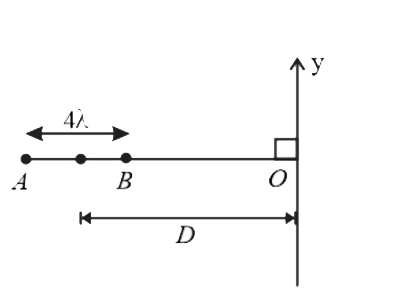
Two coherent sound sources A and B produce a sound of wavelength `lambda.` If at `t=0` a detector starts moving with constant velocity `v_(0)` from point O along y - direction, then the minimum time, after which it detects the sound of maximum intensity, is `(D gt gt lambda)`

A

`(sqrt7D)/(v_(0))`

B

`(D)/(3v_(0))`

C

`(D)/(v_(0))`

D

`(sqrt7D)/(3v_(0))`

Text Solution

Verified by Experts

The correct Answer is:

D
Promotional Banner

Similar Questions

Explore conceptually related problems

Two sound sources emitting sound each of wavelength lambda are fixed at a given distance apart. A listener moves with a velocity u along the line joining the two sources. The number of beats heard by him per second is

A particle of mass m is moving with constant velocity v_(0) along the line y=b . At time t=0 it was at the point (0,b) . At time t=(b)/(v_(0)) , the

2 loudspeakers are emitting sound waves of wavelength lambda with an initial phase difference of pi/2 at what minimum distance from O on line AB will one hear a maximum

An interference is observed due to two coherent sources separated by a distance 5lambda along Y-axis, where lambda is the wavelength of light A detector D is moved along the positive X -axis The number of point on the X-axis excluding the points x=0 and x=infty at which resultant intensity will be maximum are

A source of sound and a detector are placed at the same place on ground At t=0 , the source S is projected towards reflector with velocity v_0 in vertical upward directon and reflector starts moving down with constant velocity v_0 At t-0 , the vertical separation between the reflector and source is H((gtv_0^2)/(2g)) . The speed of sound in air is v(gtgtv_0) , Take f_0 as the frequency of sound waves emitted by source. Based on above information answer the following questions. Q. Wavelength of sound waves as received by detector before reflection at t=(v_0)/(2g) is

A source of sound and a detector are placed at the same place on ground At t=0 , the source S is projected towards reflector with velocity v_0 in vertical upward directon and reflector starts moving down with constant velocity v_0 At t-0 , the vertical separation between the reflector and source is H((gtv_0^2)/(2g)) . The speed of sound in air is v(gtgtv_0) , Take f_0 as the frequency of sound waves emitted by source. Based on above information answer the following questions. Q. Wavelength of sound waves as received by detector before reflection at t=(v_0)/(2g) is

A source of sound and a detector are placed at the same place on ground At t=0 , the source S is projected towards reflector with velocity v_0 in vertical upward directon and reflector starts moving down with constant velocity v_0 At t=0 , the vertical separation between the reflector and source is H((gtv_0^2)/(2g)) . The speed of sound in air is v(gtgtv_0) , Take f_0 as the frequency of sound waves emitted by source. Based on above information answer the following questions. Q. Frequency of sound received by detector after being reflected by reflector at t=(v_0)/(2g) is

A source of sound and a detector are placed at the same place on ground At t=0 , the source S is projected towards reflector with velocity v_0 in vertical upward directon and reflector starts moving down with constant velocity v_0 At t-0 , the vertical separation between the reflector and source is H((gtv_0^2)/(2g)) . The speed of sound in air is v(gtgtv_0) , Take f_0 as the frequency of sound waves emitted by source. Based on above information answer the following questions. Q. Frequency of sound waves emitted by source at t=(v_0)/(2g) is

Two identical source moving parallel to each other at seperation 'd' are producing sounds of frequency 'f' and are moving with constant velocity v_(0) . A stationary .observer 'O' is on the line of motion of one of the sources. Then the variation of beat frequency heard by O with time is best represented by: (as they come from large distance and go to a large distance)

Two coherent sources emit light of wavelength lambda . Separation between them, d = 4 lambda . If a detector moves along the y-axis, what is the maximum number of minima observed?
