Home
Class 12
CHEMISTRY
Find out the compounds that will disprop...

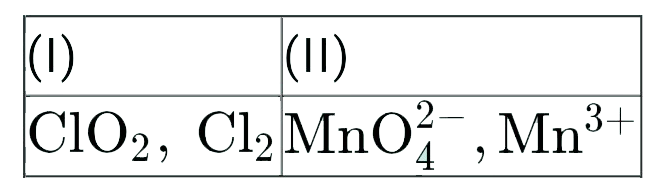
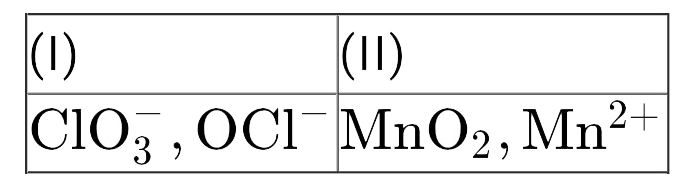
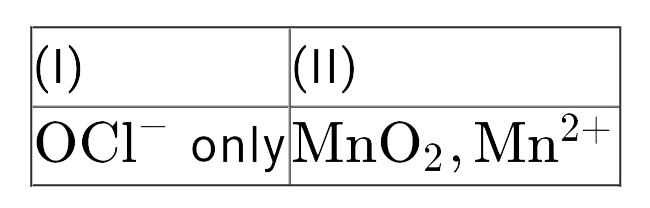
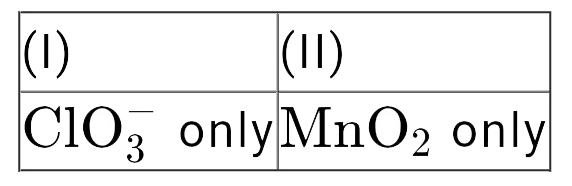
Find out the compounds that will disproportionate in their aqueous solution.
`(I)ClO_(4)^(-)overst(+0.36V)rarr ClO_(3)^(-) overset(+0.33V)rarr ClO_(2) overset(+0.66V)rarr OC l^(-)overset(+0.40V)rarr(1)/(2)Cl_(2)overset(+1.36)rarr Cl^(-)`
`(II)MnO_(4)^(-)overset(+0.56)rarrMnO_(4)^(2-)overset(+2.22V)rarrMnO_(2)overset(+0.95V)rarrMn^(3+)overset(+1.55)rarrMn^(2+)overset((-0.19)V)rarrMn`

A

B

C

D

Text Solution

AI Generated Solution

The correct Answer is:

To determine which compounds will disproportionate in their aqueous solution, we need to analyze the given half-reactions and their standard reduction potentials. Disproportionation occurs when a species can simultaneously be oxidized and reduced, which is indicated by the reduction potentials of the half-reactions. ### Step-by-Step Solution: 1. **Identify the Half-Reactions and Their Potentials**: - For the first set: - \( \text{ClO}_4^{-} \) to \( \text{ClO}_3^{-} \) (E = +0.36 V) - \( \text{ClO}_3^{-} \) to \( \text{ClO}_2 \) (E = +0.33 V) - \( \text{ClO}_2 \) to \( \text{OCl}^{-} \) (E = +0.66 V) - \( \text{OCl}^{-} \) to \( \frac{1}{2} \text{Cl}_2 \) (E = +1.36 V) - \( \frac{1}{2} \text{Cl}_2 \) to \( \text{Cl}^{-} \) (E = +0.40 V) - For the second set: - \( \text{MnO}_4^{-} \) to \( \text{MnO}_4^{2-} \) (E = +0.56 V) - \( \text{MnO}_4^{2-} \) to \( \text{MnO}_2 \) (E = +2.22 V) - \( \text{MnO}_2 \) to \( \text{Mn}^{3+} \) (E = +0.95 V) - \( \text{Mn}^{3+} \) to \( \text{Mn}^{2+} \) (E = +1.55 V) - \( \text{Mn}^{2+} \) to \( \text{Mn} \) (E = -0.19 V) 2. **Check for Disproportionation**: - A species will disproportionate if the reduction potential of the product formed by reduction is greater than that of the reactant. - **For Chlorine Compounds**: - **ClO2**: - Reduction potential from ClO2 to ClO3 is +0.33 V (left side). - Reduction potential from ClO2 to OCl- is +0.66 V (right side). - Since +0.66 V > +0.33 V, ClO2 will disproportionate. - **Cl2**: - Reduction potential from Cl2 to Cl- is +0.40 V (right side). - Reduction potential from Cl2 to ClO4- is +1.36 V (left side). - Since +1.36 V > +0.40 V, Cl2 will also disproportionate. - **For Manganese Compounds**: - **MnO4^{2-}**: - Reduction potential from MnO4^{2-} to MnO4^{-} is +0.56 V (left side). - Reduction potential from MnO4^{2-} to MnO2 is +2.22 V (right side). - Since +2.22 V > +0.56 V, MnO4^{2-} will disproportionate. - **Mn^{3+}**: - Reduction potential from Mn^{3+} to Mn^{2+} is +1.55 V (right side). - Reduction potential from Mn^{3+} to MnO2 is +0.95 V (left side). - Since +1.55 V > +0.95 V, Mn^{3+} will also disproportionate. 3. **Conclusion**: - The compounds that will disproportionate in their aqueous solution are: - ClO2 - Cl2 - MnO4^{2-} - Mn^{3+} ### Final Answer: The compounds that will disproportionate in their aqueous solution are ClO2, Cl2, MnO4^{2-}, and Mn^{3+}.
Promotional Banner

Similar Questions

Explore conceptually related problems

Predict whether Tl^(oplus) will disproportionate in aqueous solution : Tl^(3+) overset (1.25 V) rarr Tl^(oplus) overset (-0.34 V) rarr Tl .

C_(2)H_(4) overset(Br_(2))rarr X overset(KCN)rarr Y, Y is

overset(Br_(2))underset(hv)rarr (A) overset("alc. KOH")rarr (B) overset(OsO_(4))rarr (C ) overset(HlO_(4))rarr(D)," Identify 'D'"

The product D of the reaction CH_(3)Cl overset( KCN) ( rarr) ( A) overset( H_(2) O) ( rarr) (B) overset( NH_(3))(rarr) ( C ) overset( Delta)( rarr) ( D ) is

CH_(3)CH=CH_(2)overset(NBS)rarr A overset(KCN)rarr B overset(OH^(-)//Delta)rarr C overset(P//Br_(2))rarr D overset(NH_(3))rarr E overset(Delta)rarr F

CH_(3)CH_(2)CH_(2)OHoverset(PBr_(5))rarr(A)overset(KOH(Alc))rarr(B)overset(HBr)rarr(C)overset(NH_(3))rarr(D) Identify the product

F_3C-CH=CH_2 overset(HBr)(rarr) (A) overset(Nal) underset(dry . "acetone")(rarr) (B)

Using the following Latimer diagram for bromine, pH=0, BrO_(4)^(-) overset(1.82 V)rarr BrO_(3)^(-)overset(1.50 V)rarr HBrO overset(1.595 V) rarr Br_(2) overset(1.06552 V) rarr Br^(-) the species undergoing disproportionation is

Identify A to G in the following. (a) overset(Br_(2), C Cl_(4))rarr A overset(KCN)rarr B overset(H_(3)O^(+))rarr C (b) overset(Br_(2), C Cl_(4))rarr D overset(KCN)rarr E overset(H_(3)O^(+))rarr G

A overset(Cl_(2))(rarr) B overset("AgCN")(rarr) C overset([H])(rarr) (CH_(3))_(2) NH Reactant [ A ] is :
