Home
Class 12
PHYSICS
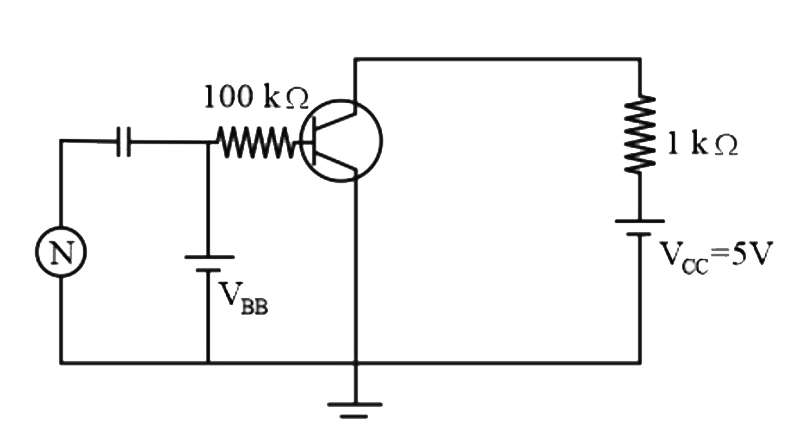
V("BB") can vary between 0 and 5 V. Find...

`V_("BB")` can vary between 0 and 5 V. Find the minimum value of base current and `V_("BB")`, so that transistor works in saturation mode. `["Given "beta =200 and V_("BE")=1V]`

A

`20muA, 2.8V`

B

`25muA, 3.5V`

C

`20muA, 3.5V`

D

`25muA, 2.8V`

Text Solution

Verified by Experts

The correct Answer is:

C
Promotional Banner

Similar Questions

Explore conceptually related problems

In common emitter transistor as shown in Fig., the V_(BB) supply can be varied from 0 V to 5.0V. The Si. Transistor has beta_(ac)=250 and R_(B)=100kOmega, R_(c)=1k Omega,V_(C C)=5.0V . Assume that when the transistor is saturated, V_(CE)=0V and V_(BE)=0.8V . Calculate the minimum base current, for which the transistor will reach saturation. Hence, determine V_(i) when the transistor is 'switched on' find ranges of V_(i) for which the transistor is switched off and switched on.

In the figure, given that V_(BB) supply can vary from 0 to 5.0V,V_(CC)=5V,beta_(dc)=200,R_(B)=100KOmega,R_(C)=1KOmega and V_(BE)=1.0V , The minimum base current and the input voltage at which the transistor will go to saturation, will be, respectively:

In a common emitter transistor circuit, the base current is 40 muA , then V_(BE) is

Find the potential difference V_(a)-V_(b) between the points (1) and (2) shown in each part of Fig.

Consider the circuit arrangnent shown in Fig. for studying input and output characteristics of npn transistor in CE configuration. Select the values of R_ and R_ for a transistor whose V_(BE)=0.7V , so that the transistor is operating at point Q as shown in the characteristics shown in Fig. Given that the input impedance of the transistor is very small and V_(C C)=V_(BB)=16V , also find the voltage gain and power gain of circuit making appropriate assumptions.

In the circuit shown in Fig. when the input voltage of the base resistance is 10V, V_(be) is zero and V_(ce) is also zero. Find the values of I_, I_ and beta .

Graphical soluton of a two body head on collision A block A of mass m moving with a uniform velocity v_(0) strikes another identical block B kept at rest on a horizontal smooth surface as shown in the figure (i). We can conserve linear momentum. So mv_(0)=mv_(A)mv_(B) ( v_(A) and v_(B) are the velocities of the blocks after collision) :. v_(0)=v_(A)+v_(B) .........(i) If the collision is perfectly elastic 1/2 mv_(0)^(2)=1/2 mv_(A)^(2)+1/2 mv_(B)^(2) impliesv_(0)^(2)=v_(A)^(2)+v_(B)^(2) ......(ii) Both the above equation (i) and (ii) are plotted on v_(A)-v_(B) plane as shown in figure (ii). This plot can be used to find the unknowns v_(A) and v_(B) . For example the solution of the situation in figure (i) is v_(A)=0,v_(B)=v_(0) (point y in the plot) Because v_(A)=v_(0), v_(B)=0 (point x in the plot) is not physically possible. In a situation block A is moving with velocity 2m//s an strikes another identical block B kept at rest. The v_(A)-v_(B) plot for the situation is shown. m and l are the intersection points whose v_(A), v_(B) coordinaes are given in the figure. The coefficient of restitution of the collision is

Find the equivalent resistance of the network shown in the figure between the points A and B if (i) V_(A) gt V_(B) (ii) V_(A) lt V_(B)

Graphical soluton of a two body head on collision A block A of mass m moving with a uniform velocity v_(0) strikes another identical block B kept at rest on a horizontal smooth surface as shown in the figure (i). We can conserve linear momentum. So mv_(0)=mv_(A)mv_(B) ( v_(A) and v_(B) are the velocities of the blocks after collision) :. v_(0)=v_(A)+v_(B) .........(i) If the collision is perfectly elastic 1/2 mv_(0)^(2)=1/2 mv_(A)^(2)+1/2 mv_(B)^(2) impliesv_(0)^(2)=v_(A)^(2)+v_(B)^(2) ......(ii) Both the above equation (i) and (ii) are plotted on v_(A)-v_(B) plane as shown in figure (ii). This plot can be used to find the unknowns v_(A) and v_(B) . For example the solution of the situation in figure (i) is v_(A)=0,v_(B)=v_(0) (point y in the plot) Because v_(A)=v_(0), v_(B)=0 (point x in the plot) is not physically possible. If the collision is perfectly inelastic, then the v_(A)-v_(B) plot is

In the cuircuit shown here the transistor used has a current gain beta=100 . What should be the bias resistor R_(BE) so that V_(CE)=5V("neglect "V_(BE))
