Home
Class 12
PHYSICS
Two bodies of equal masses are heated at...

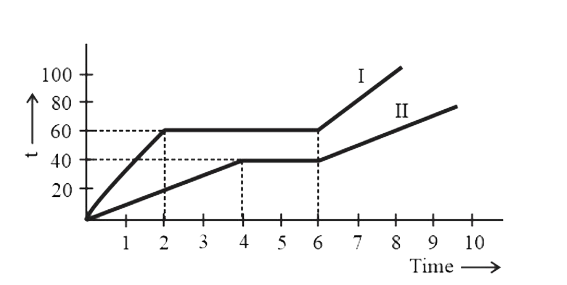
Two bodies of equal masses are heated at a uniform rate under identical conditions. The change in temperature in the two cases is shown graphically. The ratio of their specific heats in the solid state is

A

`1:3`

B

`1:2`

C

`2:1`

D

`1:4`

Text Solution

Verified by Experts

The correct Answer is:

A
Promotional Banner

Similar Questions

Explore conceptually related problems

Two bodies of equal masses are heated at a uniform rate under identical conditions. The change in temperature in the two cases in shown graphically. What are their melting points? Find the ratio of their specific heats and latent heats.

Two substances A and B of equal mass m are heated by uniform rate of 6 "cal"s^(-1) under similar conditions. A graph between temperature and time is shown in figure. Ratio of heat absorbed H_(A) //H_(B) by them during complete fusion :-

Two bodies of equal masses are moving with uniform velocities v and 2v. Find the ratio of their kinetic energies

A substance initially in solid state at 0^@ C is heated. The graph showing the variation in temperature with the amount of heat supplied is shown in Fig. 11.7. If the specific heat capacity of the solid substance is 500 J kg^(-1)^@C^(-1) , use graph to find : (i) the mass of the substance, and (ii) the specific latent heat of fusion of the substance in the liquid state.

During heat exchange, temperature of a solid mass does not change. In this process, heat

Two liquids A and B are at 30^@C and 20^@C , respectively When they are mixied in equal masses, the temperature of the mixture is found to be 26^@C . The ratio of their specific heat is

Boiling water is changing into steam. Under this condition the specific heat of water is

Boiling water is changing into steam. Under this condition the specific heat of water is

Under what conditions is the heat of reaction equal to enthalpy change?

Under identical conditions of temperature and pressure the ratio of the rates of effusion of O_(2) and CO_(2) gases is given by
