Home
Class 12
CHEMISTRY
AgNO(3)(aq.) was added to an aqeous KCl ...

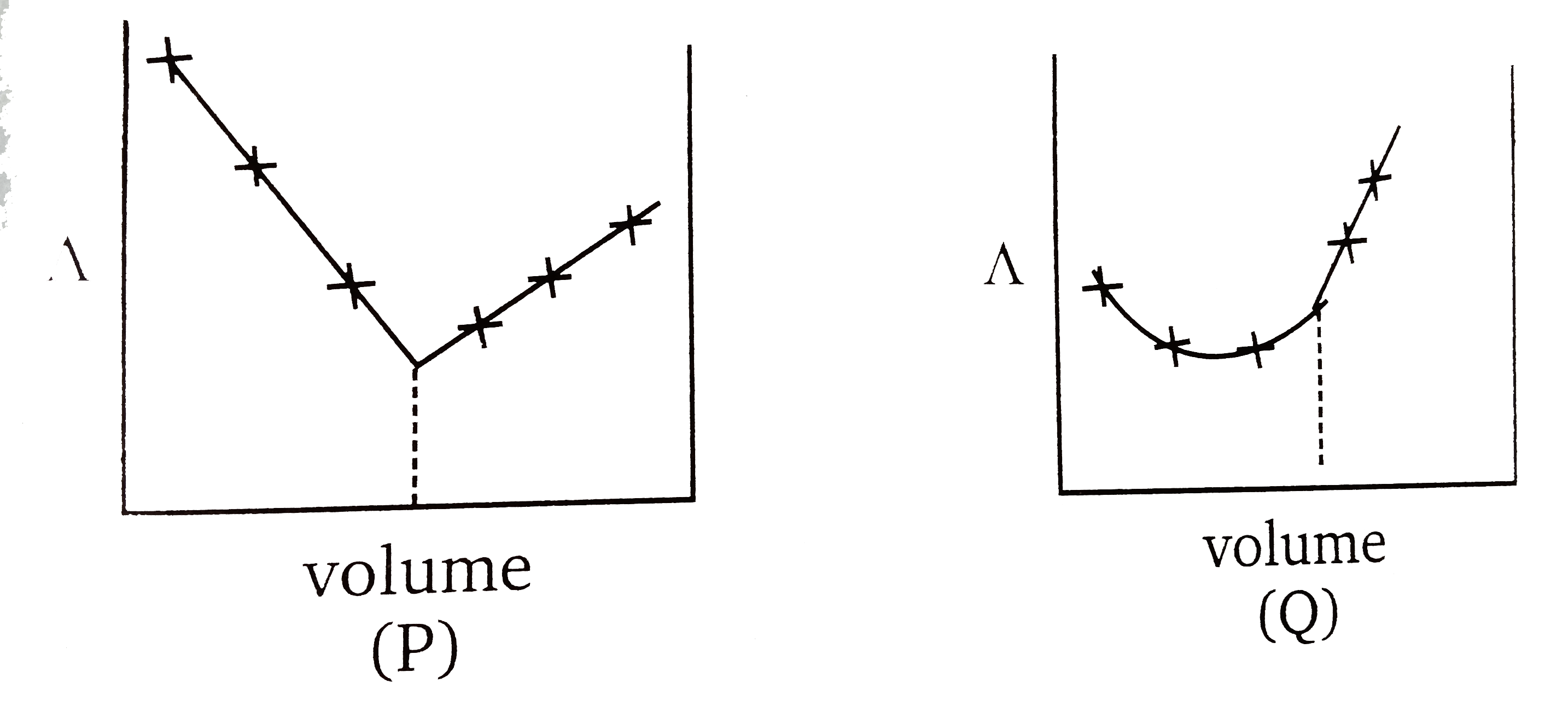
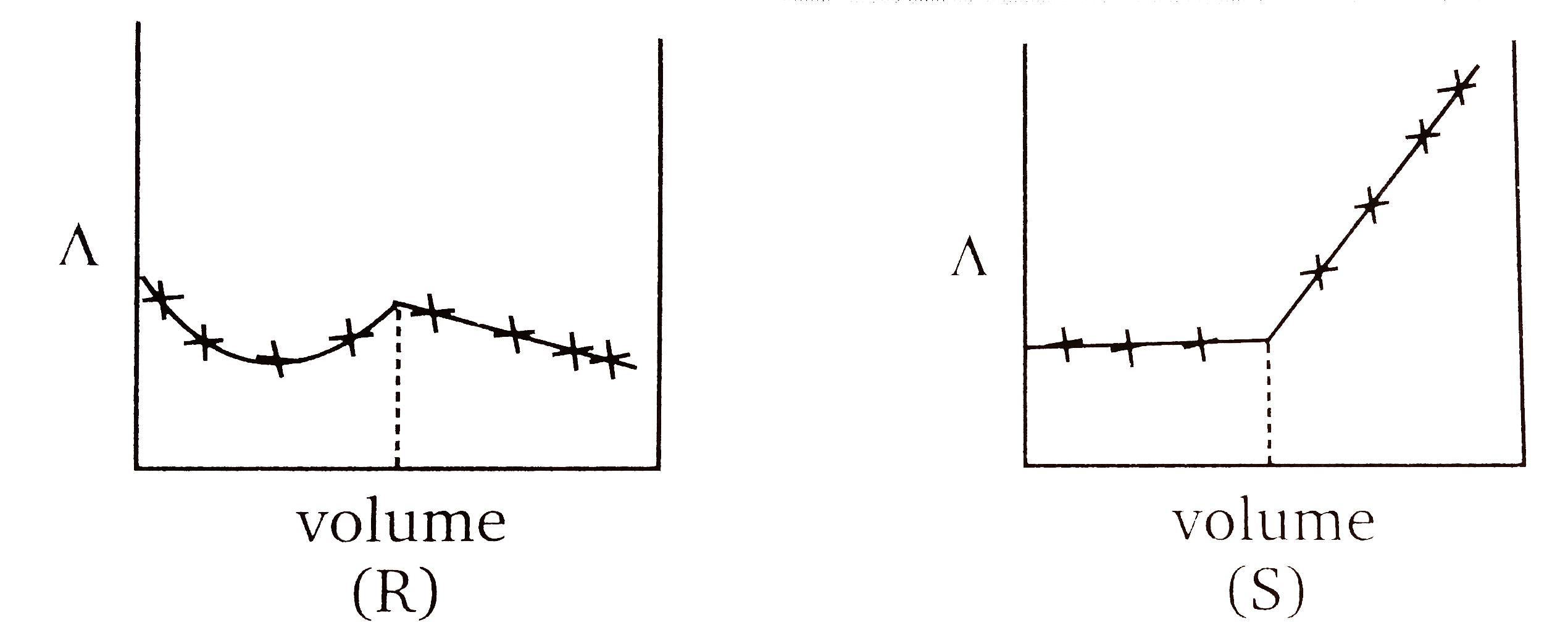
`AgNO_(3)(aq.)` was added to an aqeous `KCl` solution gradually and the conductivity of the solution was measured. The plot of conductance `(Lambda)` versus the volume of `AgNO_(3)` is :

A

(P)

B

(Q)

C

(R )

D

(S)

Text Solution

Verified by Experts

The correct Answer is:

D
Promotional Banner

Similar Questions

Explore conceptually related problems

AgNO_(3)(aq) was added to an aqueous KCl solution gradually and the conductivity of the solution was measured. The plot conductivity of the solution was measured. The plot of conductance (wedge) versus the volume of AgNO_(3) is

The conductivity of 0.10 M solution of KCl at 298 K is 0.025 S cm Calculate its molar conductivity.

What will be the products of electrolysis of AgNO_(3) solution in water with platinum electrodes ?

We have taken a saturated solution of AgBr , whose K_(sp) is 12xx10^(-14). If 10^(-7)M of AgNO_(3) are added to 1L of this solutino, find the conductivity ( specific conductance ) of the solution in terms of 10^(-7)S m^(-1) units. Given : lambda^(@)._((Ag^(o+)))=6xx10^(-3)S m^(2) mol^(-1) lambda^(@)._((Br^(c-)))=8xx10^(-3)S m^(2)mol^(-1) lambda^(@)._((NO_(3)^(C-)))=7XX10^(-3)S m^(2) mol^(-1)

The conductivity of 0.35M solution of KCl at 300K is 0.0275 S cm^(-1) . Calculate molar conductivity

AgNO_(3) solution will not give white precipitate with

Aqueous hypo solution on reaction with aqueous AgNO_(3) gives :

An aqueous solution of salt gives salt precipitate with AgNO_(3) solution as well as with dilute H_(2)SO_(4) . It may be

When AgNO_(3) (aq) reacts with excess of iodine, we get:

We have taken a saturated solultion of AgBr, K_(SP) is 12 xx 10^(-4) . If 10^(-7) M of AgNO_(3) are added to 1 L of this solution, find conductivity (specific conductance) of this solution in term of 10^(-7) Sm^(-1) units. Given, lambda_((Ag^(+)))^(@) = 6 xx 10^(-3) Sm^(2) mol^(-1) , lambda_((Br^(-)))^(@) = 8 xx 10^(-3) Sm^(2) mol^(-1) , lambda_((NO_(3)^(-)))^@ = 7 xx 10^(-3) Sm^(2) mol^(-1) . Neglect the contribution of solvent.
