Home
Class 12
PHYSICS
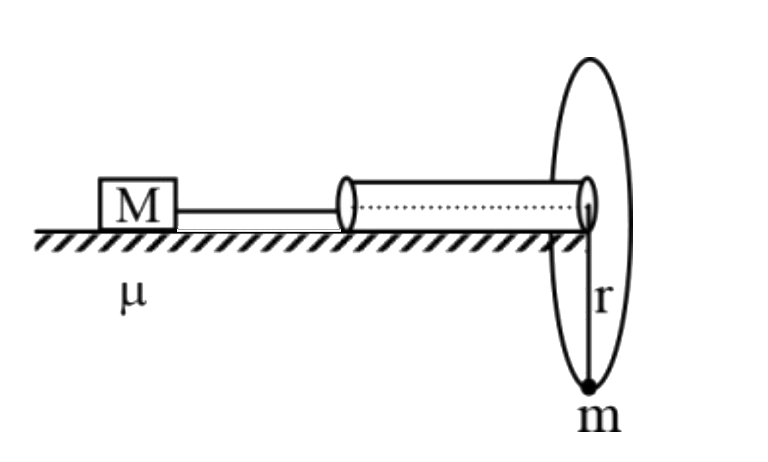
The figure below shows a block of mass M...

The figure below shows a block of mass M connected to an ideal string which passes through a thin fixed smooth pipe. On the other end, a particle of mass m is connected which revolves in a vertical circle of radius r. If the coefficient of friction between M and the surface is `mu = 2/3`, then for what minimum value of M, the block of mass m can undergo complete vertical circular motion?

A

`M_("min") = 6 m`

B

`M_("min") = 9 m`

C

`M_("min") = 3 m`

D

`M_("min") = 15 m`

Text Solution

Verified by Experts

The correct Answer is:

B
Promotional Banner

Similar Questions

Explore conceptually related problems

A block of mass m is moving on a rough horizontal surface. mu is the coefficient of kinetic friction between the block and the surface. What is the net force exerted by the surface on the block?

A cart of mass M has a block of mass m in contact with it as shown in the figure-2.133. The coefficient of friction between the block and the cart is mu . What is the minimum acceleration of the cart so that the block m does not fall ?

Two block of masses M_(1) and, M_(2) are connected with a string which passed over a smooth pulley . The mass M_(1) is placed on a tough inclined plane as shown in figure .The coefficient of friction between and block and the inclined plane is mu what should be the minimum mass M_(2) so that the block M_(1) slides upwards?

Find the minimum value of horizontal force (F) required on the block of mass m to keep it at rest on the wall. Given the coefficient of friction between the surfaces is mu .

Two blocks of masses m_(1) and m_(2) are connected by a string of negligible mass which pass over a frictionless pulley fixed on the top of an inclined plane as shown in figure. The coefficient of friction between m_(1) and plane is mu .

A block of mass m is attached to one end of a mass less spring of spring constant k. the other end of spring is fixed to a wall the block can move on a horizontal rough surface. The coefficient of friction between the block and the surface is mu then the compession of the spring for which maximum extension of the spring becomes half of maximum compression is .

Two blocks of masses m_(1) and m_(2) are connected by a spring of stiffness k. The coefficient of friction between the blocks and the surface is mu . Find the minimum constant force F to be applied to m_(1) in order to just slide the mass m_(2) .

A block of mass m is placed on the top of another block of mass M as shown in the figure. The coefficient of friction between them is mu . The maximum acceleration with which the block M may move so that m also moves along with it is

A small block of mass 'm' is placed on a plank of mass 'M'. The block is connected to plank with the help of a light string passing over a light smooth pulley as shown in figure. The co-efficient of static friction between the block and plank is mu . The co-efficient of friction between the plank and the horizontal surface is zero. What maximum horizontal force F applied on the block of mass m can make the block and plank not to slide relatively?

A block of mass m is connected with another block of mass 2m kept on a rough horizontal table by means of an ideal spring of spring constant K and a massless string as shown in the figure. The minimum coefficient of friction between the block of mass 2m and the table so that the block does not slide, when block of mass m is suddenly released, is
