Home
Class 12
PHYSICS
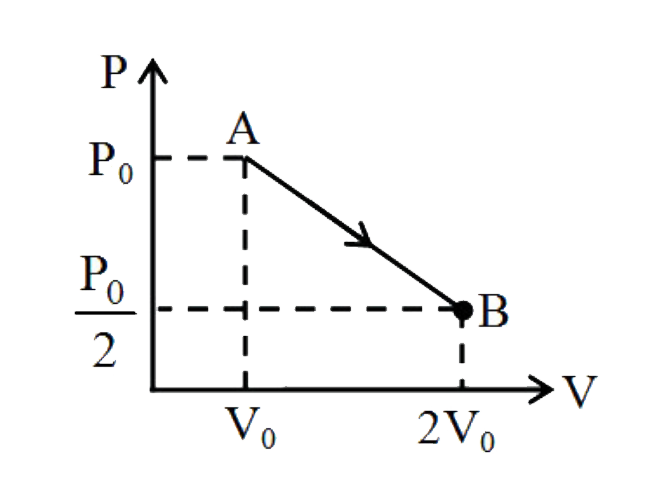
An ideal monoatomic gas undergoes an exp...

An ideal monoatomic gas undergoes an expansion from state A to state B following a process which is shown in the indicator diagram. If initially during the expansion, the gas was absorbing heat and later on it was rejecting heat, then what was the volume of the gas when it started rejecting the heat?

A

`V = 3/2 V_(0)`

B

`V = 8/5 V_(0)`

C

`V = 15/8 V_(0)`

D

`V = 12/7 V_(0)`

Text Solution

Verified by Experts

The correct Answer is:

C
Promotional Banner

Similar Questions

Explore conceptually related problems

An ideal gas undergoes isothermal expansion at constant pressure . During the process.

An ideal monoatomic gas undergoes a cyclic process ABCA as shown in the figure. The ratio of heat absorbed during AB to the work done on the gas during BC id

An ideal mono atomic gas is taken through the cyclic process shown in fig. Linear expansion from A to B following by adiabatic compression back to original state

One mole of an ideal monoatomic gas is taken through the thermodynamic process shown in the P-V diagram. The heat supplied to the system is

An ideal gas goes from the state i to the state int as shown in .the work done by the gas during the process

One mole of an ideal gas is taken from state A to state B by three different processes (a) ACB , (b) ADB and (c ) AEB as shown in the P - V diagram. The heat absorbed by the gas is

One mole of an ideal gas is taken from state A to state B by three different processes (a) ACB , (b) ADB and (c ) AEB as shown in the P - V diagram. The heat absorbed by the gas is

One mole of monoatomic gas is taken round the cyclic process. Heat absorbed by gas in process AB is

Assertion : In an isothemal expansion the gas absorbs heat and does work . Reason: In an isothermal process there is no change in internal energy of an ideal gas.

A gas undergoes change from state A to state B. In this process, the heat absorbed and work done by the gas is 5 J and 8 J, respectively. Now gas is brought back to A by another process during which 3 J of heat is evolved. In this reverse process of B to A:
