Home
Class 12
PHYSICS
A man throws a ball of mass m from a mov...

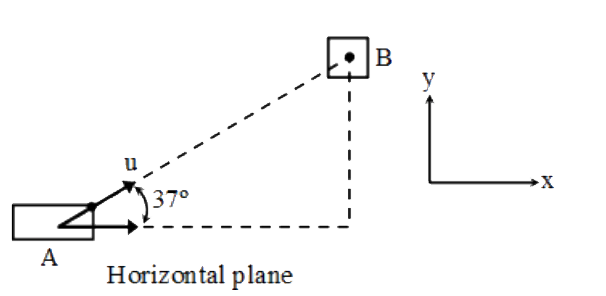
A man throws a ball of mass m from a moving plank (A). The ball has a horizontal component of velocity `u=3sqrt(34)ms^(-1)` with respect to ground towards another man standing on stationary plank (B), as shown in the figure. The combined mass of plank A with man is 2m each. The x-y plane represents the horizontal plane which is frictionless. If initially, plank A was moving with speed `uhati` with respect to ground, then the relative velocity of plank B `("in m s"^(-1))` with respect to plank A (after the man on plank B catches the ball) minus `10ms^(-1)` is

Text Solution

Verified by Experts

The correct Answer is:

7
Promotional Banner

Similar Questions

Explore conceptually related problems

A man of mass m starts moving on a plank of mass M with constant velocity v with respect to plank. If the plank lies on a smooth horizontal surface, then velocity of plank with respect to ground is

A plank with a uniform sphere placed on it rests on a smooth horizontal plane. The plank is pulled to the right by a constant force F . It the sphere does not slip over the plank, then

A man of mass m moves on a plank of mass M with a constant velocity u with respect to the plank, as shown in figure. a.If the plank rests on smooth horizontal surface, determine the velocity of the plank. .

A cylinder of mass at and radius R rolls on a stationary plank of mass M . The lower surface of the plank is smooth and the upper surface is sufficiently rough with a coefficient of friction mu . A man is to hold the plank stationary with respect to the ground, as shown Fig. The force exerted by the man to keep the plank stationary is equal to……

A man of mass m is standing on a plank of equal mass m resting on a smooth horizontal surface. The man starts moving on the plank with speed u relative to the plank. The speed of the man relative to the ground is

A man of mass m moves on a plank of mass M with a constant veloicty u with respect to the plank, as shown in figure. a.If the plank rest on smooth horizontal surface, determine the velocity of the plank. b If the man travels a distasnce L with respect to the plank, find the distance travelled by the plank with respect to te ground.

A man of mass m is standing at one end of of a plank of mass M. The length of the plank is L and it rests on a frictionless horizontal ground. The man walks to the other end of the plank. Find displacement of the plank and man relative to the ground.

A man of mass M stands at one end of a stationary plank of length L, lying on a smooth surface. The man walks to the other end of the plank. If the mass of the plank is M//3 , the distance that the man moves relative to the ground is

A man of mass M stands at one end of a stationary plank of length L, lying on a smooth surface. The man walks to the other end of the plank. If the mass of the plank is M//3 , the distance that the man moves relative to the ground is

A man of mass 80 kg stands on a plank of mass 40 kg . The plank is lying on a smooth horizontal floor. Initianlly both are at rest. The man starts walking on the plank towards north and stops after moving a distance of 6 m on the plank. Then
