Home
Class 12
CHEMISTRY
X gives white turbidity with Lucas reage...


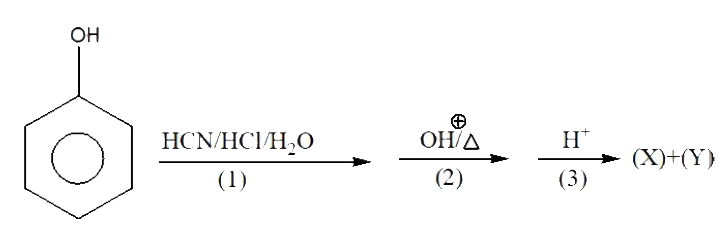
X gives white turbidity with Lucas reagent instantly. X and Y both turn blue litmus solution red. Y can be:

A

p- Hydroxy benzoic acid

B

p - Hydroxy benzaldehyde

C

m - Hydroxy benzoic acid

D

p - Hydroxy benzyl alcohol

Text Solution

Verified by Experts

The correct Answer is:

A
Promotional Banner

Similar Questions

Explore conceptually related problems

Which oxide will turn red litmus solution blue ?

A small piece of calcium metal is put into a small trough containing water. There is effervescence and white turbidity is formed. What do you observe when a few drops of red litmus solution are added to the turbid solution ?

Salt (A) is a white deliquescent solid. On heating the solid, brown fumes were evolved. On adding NaOH to the salt solution of (A), a white gelatinous ppt. was obtained. On adding, a drop of blue litmus solution to the ppt., a blue lake was obtained. On adding DPA to the salt solution, a deep blue colouration was obtained. Identify the salt and give the equations involved.

In the above reaction the using reagents X and Y are :

A gas 'X' combines with another gas 'Y' in the presence of a catalyst 'C' to form a colourless gas 'Z'. The gas Z gives dense white fumes with hydrogen chloride and the gas 'Y' turns red litmus blue. Name the catalyst C.

A gas 'X' combines with another gas 'Y' in the presence of a catalyst 'C' to form a colourless gas 'Z'. The gas Z gives dense white fumes with hydrogen chloride and turns red litmus blue. Write a balanced chemical equation for the formation of Z.

An unknown inorganic compound (X) loses it water of crystallisation on heating and its aqueous solution gives the following reaction. (i) It gives a white turbidity with dilute hydrochloric acid solution. (ii) It decolourises a solution of iodine in potassium iodide. (iii) It gives a white precipitate with silver nitrate solution which turns black on standing. Identify the compound (X) and give chemical equations for the reaction at step (i) to (iii).

The reagents X and Y are respectively:

The pH values of three solution, A, B and C are given in the table. Answer the question: Which solution will turn red litmus solution blue ?

Out of butan-1-ol and butan-2-ol which will give white turbidity with Lucas reagent more readily ?
